Bicentennial Snapshot # 39 – Paddy Hill, Read’s Corners, Latta at Mount Read

Today our topic is Paddy Hill.

Dr. Samuel Beach Bradley

In 1878 Dr. Samuel Beach Bradley wrote in his journal โ€œA miniature Ireland grew up here, free from the annoyances and the oppression of the Old Country. Industry secured prosperity. It has been a saying that if there is a good farm for sale, there is an Irishman with the money to pay for it.โ€ The miniature Ireland he was referring to, of course, is what is still called today, Paddy Hill.

Emerald green from irishcentral.com

Between 1805 and 1830 the first stream of Irish immigrants came to Greece, some by way of Canada. They came from places such as County Fermanagh, Kingโ€™s County, County Wicklow, and County Wexford. These immigrants were a relatively prosperous group of families who โ€œleft Ireland decades before the potato famines of the 1840s forced millions of Irish from their impoverished homeland.โ€ Many of the men were skilled tradesmen such as stone masons, mechanics, and coopers.

Aerial of Latta Road at Mount Read, 1960s, from GHS

What they sought was land, something they were prohibited from owning in their native country. Unlike later generations of immigrants, these Irish farmers were able to purchase tracts of fertile acreage and establish themselves quickly as prosperous landowners.

By the second quarter of the century, orchards and grain crops crowned Paddy Hill and the farms prospered. Like The Rigney and the Whelehan Farm in the Picture to the right.

We will learn more about what Francis Howard Whelehan remembers about his family farm in next week’s snapshot.

Paddy Hill approached Mt Read Blvd., the 1920s, from GHS. On the left is the Rigney Farm, and on the right is a Whelehan Farm

Felix McGuire

Felix McGuire Memorial marker in Our Mother of Sorrows Cemetery photo by Joe Vitello

One of the first Irishman to settle in the area was Felix McGuire. Born in County Fermanagh (Fer-man-a) circa 1770, he arrived in Greece between 1805 and 1807. He was a leading Catholic layman in his day in Monroe County and a โ€œsubstantial figure in the history of the Town of Greece.โ€ By 1810 he was elected as a path master for the town of Northampton. The Catholic tradition in Rochester and in Greece is that Felix was the man who brought the first priest to the Rochester district to celebrate Mass in 1818. He also was a founder of St. Patrickโ€™s Cathedral in Rochester in 1823.

Nicolas Read

Nicholas Read was a contemporary of Felix McGuire. A prosperous, well-educated Irish immigrant, he took up residence in Greece circa 1823. โ€œAlready a man of substance, he purchased a considerable amount of acreage on the crest and slopes of the highest point in the town of Greece between Ridge Road and the Lake, now called after him, Mount Read.โ€ Maps labeled the intersection with Latta Road “Read’s Cornersโ€ before it was ever called Paddy Hill. A civic and religious leader, Read โ€œserved as justice of the peace for over twenty years, and for three years was one of the associate judges of the county. Many called him “Judge” Read because of his judicial positions. He was more widely known as “Squire” Read.โ€

Nicholas Read from Greece Historical Society’s Collection
Historical marker at Mt. Read and Latta, photo by Dick Halsey

The heart of the Irish community at Readโ€™s Corner was their church and Felix McGuire and Nicholas Read were instrumental in its founding. Nicholas Read donated the land for the church and cemetery. Principally through their efforts, a frame building was begun in 1829. It was named St. Ambrose Church but was more commonly called “The Church in the Woods,โ€ a name given to it by the local Native Americans. That was what the church was called before receiving the name Our Mother of Sorrows, It was the first Catholic church built in any rural area in New York State.

Diocesan historian Robert McNamara wrote: โ€œThe Irish were so numerous in the north part of Greece that for many years a long stretch of Latta Road on either side of Mount Read was flanked by an unbroken line of Irish Catholic farms. It is no surprise that the Mount came to be called โ€œPaddy Hill.โ€ But the Grecian Irish deeply resented this nickname, for “Paddy” was an ethnic slur.โ€ But it is the name that lingers to this day. Judge Read was particularly active in fighting anti-Irish/anti-Catholicism sentiments.

The image on the right is a pen and ink original art by noted cartoonist Frederick Opper (1857-1937), noted for comic strips “Happy Hooligan, Alphonse And Gaston, Her Name Was Maud” and others. Opper also drew political cartoons for William Randolph Hearst’s “New York Journal.” This single-panel cartoon dates to c. 1885, during the height of anti-Irish immigrant sentiment in America, and features a man with a bucket and paintbrush standing outside of a wooden shack decorated with shamrocks and Irish harp, with freshly painted “Down Wid Toyrunts! No More Irish Paupers Wanted In The U.S.” text. Irish woman looks out of the window as goat w/painted shamrock look on. Nightshirt w/harp image hangs off the post over the door like a flag. Opper has signed at the lower right. The lower left corner has a .5×1″ corner tip-off (not affecting art) w/2″ corner crease. Artboard has evenly aged some corner foxing and scattered dust soiling.

Printed in the New York Journal c. 1885
Frederick Burr Opper, 1857-1937

Peter Larkin

Peter Larkin from Mother of Sorrows Herald No. 2, Easter 1930, from GHS

Peter Larkin was born circa 1809 in Ireland and emigrated to this country around the age of 30. He, along with his good friend Joseph Fleming, succeeded Felix McGuire and Squire Read as leaders of the Irish Community of Readโ€™s Corners. Before coming to Greece, both men worked on a number of canal projects around New York State and in Canada. In addition to his farm, Peter was a prosperous property owner around what was known as Greece Centerโ€”the Latta/ Long Pond intersection and where the Greece Town Hall campus is today. Peter was elected supervisor of the town three times: 1861โ€“1862, 1872, and 1876.

Peter Larkin Home on Long Pond, is now home to Lang Dental Group.

Lang Dental Group Posing in front of Peter Larkin’s Homestead
Peter Larkin Home on Long Pond, now Lang Dental Group, photo by Bill Sauers

Joseph Fleming

Joseph Fleming Home, photo by Bill Sauers

We told you about Joseph Fleming and his home in Snapshot 31 – Notable Holmes in Greece NY.

Our Mother of Sorrows and Father Jean Louis Maurice

Larkin and Fleming recommended that a French priest, Father Jean Louis Maurice, or Father John Maurice as he anglicized his name, be made pastor of St. Ambrose and he was appointed in 1856. When it came time to construct a new church to replace the 30-year-old wooden frame church in 1859, Peter Larkin and Joseph Fleming were the general contractors and Peter personally built the lentils and windows of the church. They donated their labor. Father Maurice was the pastor for 39 years until his death on Christmas Day, 1895 at the age of 83.

Our Mother of Sorrows Church, photo by Bill Sauers
Peter Larkin designed the lentils and frames for the stained glass windows sit in as seen in this 1991 D&C Photo of Paddy Hill Library
"Gift of Peter Larkin and Joseph Fleming"
When you click on this image to view it full size you can see at the bottom in black text on this stained glass window it say “Gift of Peter Larkin and Joseph Fleming” on the glass

This church continued to be at the heart of the Irish community.

Father Jean Louis Maurice
Distinguished guests at the centennial celebration, June 8, 1930, from the Rochester Times Union, June 9, 1930 (from left: Governor Franklin D. Roosevelt; Guernsey T. Cross, governor’s secretary; Mrs. Eleanor Roosevelt; State Senator Frederick J. Slater, chairman of centennial committee.)

A highlight in the history of this community and its church was the centennial celebration in June 1930. Five thousand parishioners and former parishioners attended the ceremony. Governor Franklin D. Roosevelt and his wife Eleanor were among the dignitaries helping to mark the anniversary.

In 1968 it was replaced by a new church just south of the cemetery. The congregation outgrew the little church at the corner of the Latta and Mount Read Blvd building a new church could give them more room for more members to attend services and around 1950 they added a Private Catholic school on the grounds years later to help with the number of congregational members growing because the town’s population was booming. But in the 2000s Mother of Sorrows school started to see a decline in admissions of students to the school which forced the church to sell the school building and in 2017 Rochester Academy Charter School bought the building and serves as their high school.

Our Mother of Sorrows Church from dorchurches.org

Paddy Hill Library/Rochester Academy Charter School

Black and White 1990s Picture of the Inside of Paddy Hill Library
Greece Public Library before the expansion of the children’s library area on the Greece Town Campus

The old church was leased to the town of Greece for the Paddy Hill Branch Library, โ€œwith the understanding that any inside adjustments necessary could be made, but that the old red-brick Romanesque exterior would remain the same.โ€ The library closed circa 1999 with the opening of the new library on the Town Hall campus in 2000. There is a second library branch that opened up in the Dewey-Stone area but since COVID it has not reopened the small storefront location.

Between 2000 and 2017 it was used by the Greece Central School District as well for a short period for certain programs and offices due to building constraints of the district at the time. Today the building is owned by the Rochester Academy Charter School.

After Greece Central School District was done using it for some of the programs the district had running.

Look at this 1902 map and you can see that Readโ€™s Corners is still surrounded by Irish family farms.

Close up of Paddy Hill on the 1902 Map
Whelehan home on Allyndaire Farm 1438 Latta Road, photo by Bill Sauers

Today, the Whelehanโ€™s Allyndaire Farm is the last of them on Latta Road. More about them in our next Snapshot.

Paddy Hill School / Common School District # 5

Equally important to the community was its school, which was and is located across the street from Our Mother of Sorrows Church. The year after the Town of Greece was established in 1822, a new local public school, Common School District No. 5 Town of Greece was set up on the west side of the half-intersection of Latta Road and the present Mount Read Blvd. There has been a public elementary school at this intersection since 1839, either here or kitty-corner from the church, making it the second oldest continuous location in the county. The Greece Historical Society received a grant from the William C. Pomeroy Foundation to install this historical marker.

Historical marker photo by Bill Sauers
Paddy Hill School courtesy of Randy Phillips

With the school and their church established in 1829, the community โ€œbegan to envision that intersection as the nucleus of a future village.โ€ But the commercial hubs developed in Charlotte, and around the Dewey/Latta, and the Latta/Long Pond intersections. Even today the surrounding environs are predominately residential.

Our Mother of Sorrows Cemetery

Very few of the early settlers around Paddy Hill chose to leave for other places; there were many marriages among the tightly-knit families. One only has to walk the quiet paths of Our Mother of Sorrows Cemetery and read the names on the grave markers: McGuire, Read, Larkin, Fleming, Rigney, Bemish, Burns, Whelehan, McShea, Slater, Goodwin, Gallery, and Hogan. A whoโ€™s who of the early pioneers of the town. Many of the descendants of these families still reside in Greece.

Our Mother of Sorrows Cemetery photo by Joe Vitello

Thank you for joining us today, next week our Snapshot is about growing up on Paddy Hill.

mail

Bicentennial Snapshot No 38: Our Town in World War II

Today weโ€™ll tell you about the town of Greece during World War II.

Panorama of the Opening of the World War II Exhibit
Panorama of the Opening of the World War II Exhibit – Presenting the Colors
Aerial view of Long Pond Road at Latta where Wegmans supermarket is today, 1940s, from the Office of the Town Historian

Encompassing more than 50 square miles, the town of Greece in 1940 was primarily made up of farms and the population was 14,925 as of the 2010 census the town of Greece’s Population was 96,095 people that’s 3,905 people shy of 100,000 people in the town.

The town was protected by a ten-member police force led by the townโ€™s first police chief, Milton Carter, and four volunteer fire companies.

Chief Milton Carter (Right)
Charlotte High School, Lake Ave 1940s
Aerial view of John Marshall High School Ridgeway Ave Rochester, NY

There were nine churches. However, there was no town public library, nor high schools; students attended Charlotte or John Marshall High Schools in the city.

That meant if you went to school at one of the many smaller elementary schools or 1 and 2-room schools in the town of Greece you by the time it came for 9th grade you would either end up doing trade by the 9th grade or attend High School at Charlotte High School on Lake Ave in the Villiage of Charlotte prior to 1916 and in 1916 it would have been under the City of Rochester or attended John Marshall High School on Ridgeway Ave in the City of Rochester. More on the education system prior to the modern education system in a 2 part snapshot coming soon.

There were 39 registered organizations for men, women, and young people including a large chapter of the American Legion, eleven PTAs, political clubs, Grange Hall, Boys and Girls Scouts, and Firemanโ€™s Associations as well as 38 church-related groups.

Grange Hall on Ridge Road, 1945, from the Office of the Town Historian

That All changed on December 7, while it was just getting to lunchtime on the East Coast the sun was just coming, on that day Stanley Hwalek one of the veterans that we interviewed for the exhibit was stationed at Pearl Harbor here is a quote from him in 2015 for the exhibit and you can read his entire veteran’s profile by picking up a copy of Our Town in World War 2 book in the museum gift shop.

Picture of Stanley Hwalek taken in 2015 for the exhibit

โ€œWell, December 7th was just a regular Sunday morning. We were up at 6:00 because on Sundays they let us sleep a half hour longer. Usually during the rest of the week, reveille was at 5:30, but Sunday you were able to sleep until 6 oโ€™clock and they had breakfast from 6:30 until 7:30. After breakfast, I went out on deck with one of my shipmates and I had the morning newspaper. As Iโ€™m reading the paper there about 7:30 or so I looked up, we were near this Navy air station at Ford Island, I saw a lot of smoke coming out of the hangars. I said to my shipmate, โ€˜Look. The Army must be having maneuvers or something because theyโ€™re making a lot of smoke out there.โ€™ All of a sudden a plane comes over our ship and starts strafing.โ€

Stanley was one of the many veterans that survived the attack at Pearl Harbor that December 7th, 1941. On Monday, December 8th, 1941 in a full joint session of Congress President Franklin Delano Roosevelt addressed the Nation and asked for Congress to approve the Declaration of War against Japan and to respond to the attacks at Pearl Harbor.

Headline from Greece Press, December 12, 1941

Grecians answered the call to join the war effort. By March 1942, 1500 men and women had volunteered for civilian defense positions.

By the end of 1944, town residents had collected 165.5 tons of scrap metal, 384 tons of waste paper, 3 tons of rubber, 4 tons of old rags, and 200 bags of milkweed. This gun, captured from Germany during World War I, was donated to the war effort for scrap metal. These stats are from Accept, Buy and Volunteer: The Homefront Experience of the Town of Greece, New York, 1941-1945 by Timothy Dobbertin.

You can read also read the following article that the Society’s President Bill Sauers wrote and published in the Greece Post titled “A German Gun Helps Win the War” about Police Chief Milton H. Carter, who acquired a 105 mm German Howitzer. https://greecehistoricalsociety.org/2008/11/13/a-german-field-gun-helps-win-the-war/

Gordon Howe, Town Supervisor, lays a wreath on Memorial Day at the Town Hall, 1941, from the Office of the Town Historian
Victory Garden Enrollment Form, Greece Post, March 20, 1942

Residents were encouraged to plant Victory Gardens with vegetables, but to also continue to grow ornamental flowers as they would be morale boosters.

Headline, Greece Post, March 20, 1942

By the spring of 1942, 300 had enrolled. By the spring of 1944, there were more than 25 acres of Victory Gardens under cultivation in the town.

The Odenbach Shipyard was the main employer in Greece during the war years, employing thousands of workers at the 4477 Dewey Avenue plant. They made cargo barges, Y-boats, and cranes for the United States Army. At the height of production, they averaged one ship every two weeks.

Kodak, Bosch & Lomb, were also employing workers from Greece and other parts of the community as well but because of the City Annexation of where Kodak’s Lake ave facilities were, they were no longer considered the main employer located in the town boundaries.

Workers at Odenbach Shipbuilding Corp., 1943, from the Office of the Town Historian
The flag of stars flew at Greece Town Hall to call attention to the number of Greece Men and Women in service during World War II. Additional stars were added as the numbers grew. From Left to Right Town Supervisor Gordon Howe, Police Chief Milton Carter, and Lucius Bagley World War I Veteran

Almost 2,000 town residents served in the military.

War Mothers Service Organization, 1943, from the Office of the Town Historian

Families waited at home hoping and praying for the safety of their husbands, sons, and brothers.

cemetery of fallen soldiers and veterans
Photo by Veronika Valdova on Pexels.com

Thirty-four Greece residents made the ultimate sacrifice for their county. They were:

Clip 45:

Back Cover of Our Town in World War II

Of the 16 million Americans who served in World War II, there are now only about 150,000 still living. In 2015 to mark the 70th anniversary of VE day, the Greece Historical Society opened Our exhibit, Our Town in World War II.

In the Video, we Hear from William Sauers the President of the Greece Historical Society & Museum. Don Riely, was our Master of the Ceremony. Color Gaurd from VFW Post 468. 2015 Greece Town Supervisor William D. Reilich Speaking about what it was like on the homefront during World War II. Jack Foy talked out his tour of duty during World War II. Senator Joe Robach read the list of 32 soldiers. Finally Maureen Whalen the exhibit chair gave a brief overview of the exhibit. can view the entire program below.

Twelve veterans of the war were interviewed for the exhibit. Today, only one of them is still living. But their recorded interviews are available at our museum.

You can explore a digital copy of the museum exhibit that is located in the past exhibits section.

We had a great turnout for the exhibit and when the museum went to the Museum Association of New York the following year we received an award for the exhibit.

You may read about these vets and Greece during the war years in the Societyโ€™s publication Our Town in World War II by Maureen Whalen and Marie Poinan.

Thank you for joining us today. Next week our topic is Paddy Hill, What a journey we have had so far exploring the History of Greece through each snapshot that Maureen Whalen and myself Pat Worboys, and thanks to Joesph Vitello, William Sauers, and many our other contributors to these snapshots. These help you learn what life was like through different eras in the town of Greece.

mail

Bicentennial Snapshot No. 37: Unsolved Arson Case – The Holiday Inn Fire of 1978

Today we look back at the horrific fire at the Holiday Inn in Greece in which ten people lost their lives while staying at the Holiday Inn. Every year goes by when the generation of people who were are the scene of the horrific fire and the temperature was a balmy chilly 20ยฐF (-6.7ยฐC) temperature and winds out of the north around 10mph. Remember when we told you about the town of Greece didn’t join the 9-1-1 call center and operations until around 1986, before that time you would have to call the station directly or if the business had an alarm system properly wired up to the fire company’s alarm system to alert the firefighters that there was a fire at certain places of business, this also played a roll in the case of this tragic hotel fire that took the lives of ten people.

Even though the Ridge Road Fire District and North Greece Fire Department are celebrating their centennials this year there is one fire that has affected everyone at both. Every fire district in the town has battled large and small fires, auto accidents, attended training, practiced at the fire training grounds, routine fire inspections, community programs, and outreach, but never prepared them for what would become Ridge Road’s most unique fire they had to deal with in the companies first 100 years of service.

Chase-Pitkin fire, August 30, 1980, courtesy of Matthew Pillsbury RRFD

Ridge Road Fire Department has battled many fires,

largeโ€ฆ

โ€ฆand small.

Greece Baptist Church courtesy of Matthew Pillsbury RRFD
Holiday Inn Fire, 1978, courtesy of Matthew Pillsbury RRFD

But never anything like the Holiday Inn Fire on November 26, 1978.

On Sunday, November 26, 1978, there were about 200 people staying at the Holiday Inn in Greece. According to the report Fire Command, Volume 46. National Fire Protection Association, 1979 in that publishing it states there were 91 guest rooms at the hotel, but the exact number of guest rooms on November 28, 1978, is unknown due to the owner of the hotel began changing some of the guest rooms were converted into conference rooms. Among the guests were visitors from an Ontario, Canada bus tour here to take advantage of Thanksgiving weekend shopping specials, members of two wedding parties, a John Marshall alumna in town for her reunion, and attendees at the hotelโ€™s Saturday night singles party.

Holiday Inn postcard courtesy of Bill Sauers
Holiday Inn sign courtesy of Bill Sauers

Around 2:30 am that frosty Sunday morning, a fire started among the paper products and towels stored in a closet area tucked under a first-floor stairway and that metal door for the closet area was not fire-rated or UL-labeled. The blaze spread quickly up the stairs where the fire doors had been propped open, raced down corridors, ignited the ceilings, and invaded the roof. And with strong winds from out of the north-north-west, and the temperature was hovering around 24.2ยฐF (-4.333 ยฐC) but with a wind chill, it would make it feel like 16.1ยฐF (-8.333ยฐC).

Two off-duty firefighters, one from the Greece Road fire department, the other an Albion FD fire chief, each driving on Ridge Road on the way home from a different workplace, spotted the orange glow of the flames approximately eight minutes after the fire started. The Greece firefighter radioed in the fire from his car and they both entered the building to start evacuating guests. Other people were calling from nearby payphones to report the fire. 911 wasnโ€™t instituted until 1986 in Rochester (even later in Greece) and of course, cell phones hadnโ€™t been invented yet.

Greece 1970 Interactive Historic Data Map Monroe County https://maps.monroecounty.gov/Html5Viewer2/index.html?viewer=Historic#
Fighting the inferno, 1978, courtesy of Matthew Pillsbury RRFD

Greece Ridge put in the call for mutual aid to help with the scene unfolding at the Holiday Inn on Ridge Road next to Corona Road. The companies that came to assist Greece Ridge were Barnard, North Greece, and the City of Rochester, who fought the blaze for two hours with more than 125 firefighters. Ten ambulances were needed at the scene. Gene Preston who was a member of Kodak Fire at the time, remembers that Kodak Fire did offer to lend assistance by connecting Greece Ridge trucks to Kodak’s water source on the ground of the Latona Road Complex, but Greece Ridge turned down Kodak Fire Department’s offer to hook up to their water source.

Rescue crews piloted 170 guests, most of them still in their night clothes and many barefoot, outside into the 16-degree cold.

As you can see on this map (Greece Ridge) Ridge Ridge had command of the scene and the Greece Ridge chief became the incident commander, he issued the call to request mutual aid as Barnard, North Greece, and City of Rochester companies arrived at the scene, Greece Ridge fire chief began assigning the assisting companies where to deploy their firefighting equipment at the scene. The blue lines on this map are hoses that ran to the water from the fire hydrants to the trucks and from truck to truck. The green lines on this map of the scene represent the hoses that were in the firefighter’s hands. A large contingent of the firefighting efforts was coming from pumper 253 on the west side of where the origin of the fire started. The red arrows represent the direction of where the fire was traveling outward from the origin to the shaded reddish, orangish zone was where the fire able to be stopped from consuming the rest of the structure.

What is a Squrtโ„ข๏ธ fire truck? The Squrtโ„ข๏ธ fire truck is a brand of fire truck Trademarked by SNORKEL FIRE EQUIPMENT COMPANY CORPORATION on November 4, 1969, as you can see in the Trademark filing on the USPTO website https://tmsearch.uspto.gov/bin/showfield?f=doc&state=4810:yri038.2.3 and licensed to different manufacturers that built these kinds of fire trucks like the one in service in North Greece was built by Young Fire Equipment Corporation in Buffalo, New York.

map of units on scene
Map of Units on Scene at Holiday Inn Fire courtesy of Matthew Pillsbury RRFD

Here is a list of the abbreviations of each of the different trucks at the scene means after each of the different fire fighting apparatuses is the number of that engine.

  • E – Engine
    • E-10
    • E-11
  • L – Ladder
    • L-221
    • L-251
  • M – Medic
    • M-220
  • R – Rescue Engine
    • R-222
  • P – Pumper
    • P-251
    • P-252
    • P-253
    • P-254
    • P-255
    • P-273
    • P-274
    • P-453
  • T – Truck
    • T-3
    • T-8
  • Squrtโ„ข๏ธ
    • Squrt 1
After the fire, in 1978, courtesy of Matthew Pillsbury RRFD

By 4:30 the fire was out, but the building was a total loss. A few guests leaped from second and third-story windows to save themselves. Thirty-five people were injured. Tragically, ten people perished in the fire from smoke inhalation.

We Remember the guest that perished that early morning on November 26th, 1978

List of Canadian citizens who died in the Holiday Inn Fire

They were: Rubina โ€œRuthโ€ Cushinan, age 81, and her daughter Ruby Cushinan, age 61, from York, Ontario, Canada; four people from Etobicoke, Ontario, Maguerrette Duncan, age 57, 67-year-old Edward Farley and his 62-year-old wife, Lorene, and Pamela Sagriff, age 30, and from Bramalea, Ontario, Huguette Sundude, age 30.

Names of the remaining three people who died

Joyce Plumb age 42 from Arlington Virginia who had attended her 25th high school reunion from John Marshall High School the day before; Stephen Gregory Ford, age 29, from Ypsilanti, Michigan who was in Rochester for his best friendโ€™s wedding, and from Pompano Beach, Florida, Nancy Garrett, age 26.

white rose
Photo by Aidan Nguyen on Pexels.com

Results of the Fire Investigation

The hotel had a host of structural faults that contributed to the easy spread of the conflagration: The โ€œprimary factors that led to the fatalities in this incident were the combination of the highly combustible interior finish, [and] unprotected openings that existed in the stairway,โ€ there was only one vertical firewall between the two wings and the firewalls in the buildings did not extend to the roof, allowing the fire to rip through the top floor of each wing.

Aerial view of the hotel courtesy of Matthew Pillsbury RRFD
Sprinkler head from fessa.com.au

The hotel was equipped with a fire alarm system that included manual-pull stations and combination rate-of-rise, fixed-temperature thermal detectors as initiating devices yet it failed to do what it was intended to do to prevent the loss of life. It lacked a sprinkler system and Emergency Lighting. The alarm system wasn’t connected to the Greece-Ridge Fire Department or any other security agency.

The alarm system consisted only of one bell in the middle of each of the two wings’ five floors. The alarm didnโ€™t have a distinctive sound nor was it loud enough. Guests didnโ€™t recognize it as a fire alarm; they thought it was a phone in the room or an alarm clock. Furthermore, when hotel employees realized the alarms were ringing, they rushed to get people out, but no one remembered to call the fire department.

Burned-out corridor, courtesy of Matthew Pillsbury RRFD
Greece Police Headquarters Precinct 1, 1983 Office of the  Town Historian
Greece Police Headquarters Precinct 1, 1983 Office of the Town Historian

As news of the fire spread, the police department was flooded with calls. One volunteer Doug Worboys, recalls that after the fire he arrived home at 10:30 am, grabbed a little sleep, and returned to work the noon to 11 pm shift at the police dispatch office desk with fellow dispatchers Ron Timmons and Jim Leary. โ€œWe had callers from throughout the US and Canada; the farthest away, I think, was Puerto Rico. We referred most of the Holiday Inn inquiry calls to the front desk officer who was assigned to take all those types of calls. The next day they had a special line set up for further calls. You hear things like that happening in other places, but you never expect one like that in your own town. That day was a very busy day with all those calls along with calls for normal situations that occur day to day. That day was a very somber day for us dispatchers and all people involved in this fire.โ€

Although at first it was said that the fire was accidental, Police Chief Gerald Phelan, when speaking to reporters at the time, said that โ€œhis gut told him the fire was nonetheless suspicious due to its speed and intensity.โ€

Police Chief Gerald Phelan with Greece Town Supervisor Don Riley from the Office of the Town Historian

John Stickever joins the case

John Stickever, photo from his obituary New York Daily News, February 22, 2017
Butanone. (2022, November 8). In Wikipedia. https://en.wikipedia.org/wiki/Butanone

John Stickever joined the FDNY in 1959 and was assigned to Engine Co. 231 in Brooklyn. He became a fire marshal six years later. Durning Stickevers first 37 years as a fire marshall where he investigated numerous fire scenes where some were arson, and some were just accidents. In 1978, John Stickever, a New York City Fire Firefighter was just promoted to the rank of Supervising Fire Marshall in July 1978 and was an Investigator who specialized in arson and โ€œessentially wrote the book on fire investigation training,โ€ which is linked below. Mid-week following the fire on November 26, 1978, is when then Greece Police Chief Gerald Phelan contacted Commission Augustus Anthony Beekman of the New York City Fire Department to see if the City could send someone to help the Greece Police and Greece Ridge Fire Department to examine the Holiday Inn fire scene. It was Commissioner Augustus Anthony Beekman who called Stickever at home and the commissioner said he was the one who was selected to head to upstate New York to help with a case in Greece, NY.

When Stickever arrived he started to have firefighters clear the floor and in front of doors and other areas in the hotel, he began to notice things that the Greece Police and Greece Ridge did not see at the time of the fire which stood out to him. Stickever concluded that an accelerant of some kind had been used in starting the fire and declared it arson and the ten deaths were now ten murders. Stickever with his knowledge found burn patterns, and damage to the kickplate on the fire doors, and when the results came back from the labs, they found traces of Methyl Ethyl Ketone (MEK) otherwise known as Butanone was used as an accelerant which made the fire grow quickly in the stairwell, and with the winds at 2 A.M. were at about 10 miles an hour out of the North which help spread the fire quickly through the hotel, with that information both Stickever and then Assistant Monroe County District Attorney Crane, during in 1978 knew it had to be someone with the knowledge of MEK. In 1978 Stickever and then ADA Crane believe that someone would have to have knowledge of MEK and firefighting skills to know that MEK according to ilo.org a website that has information on all different types of hazmat chemicals notes under PHYSICAL & CHEMICAL INFORMATION that the Physical State and Appearance is a colorless liquid with a characteristic odor from ILO and WHO 2021. The other types of accelerants would have been easily found but because MEK was used as the accelerant it made it more difficult for the firefighters to fight the fire. If the chief of Greece Ridge had requested the airport chemical fire truck from the airport which was a carbon dioxide, dry agents, or alcohol-resistant foam-based fire suppression agent in its tank would have halved the time for the first responders that day, but no one knew what accelerant was used to start it.

16×9 Program on Global News From Canada

According to an interview Stickerver did with Crime Beat TV’s 16×9 – Lost in the Flames: Legacy of historic Holiday Inn fire and aired April 30, 2012, on Global News a division of Shaw Media Inc., in Canada, he remembers the interview one Greece Ridge firefighter said on the news and the body language of that firefighter on video, it set off some signs that were a sign that Stickever could tell that he was the critical suspect because during that interview that firefighter said he was driving towards the My Apartment Bar when he called the fire in. Stickevers pushed for the state to give marshals “police officer” status so they can enforce just like the police officers but with the ability to issue tickets, fines, fees, and official notices on properties that violate fire codes, fire safety, or other aspects of a building that would make the fire marshals not want to give okay to open the building or had to close the place down until it was brought up to code to ensure that it was safe for the public to enter the said structure with that state approved this the bill that created and gave the power to create a program on fire investigation and arson in every municipality in New York State you can read the bill along with the supporters and documentation by reading the New York State bill jackets – L-1979-CH-0225 by clicking the link here to see the full text of that bill https://nysl.ptfs.com/aw-server/rest/product/purl/NYSL/i/f6d59c1f-e1a7-405a-9359-6f4fe1deacd8

Here is a link to the article that was written by John Stickever in the Federal Bureau of Investigation Law Enforcement Bulletin in 1986 that describes the way he does arson investigations https://books.google.com/books?id=d_dcT71FVsUC&lpg=PA1&ots=auNtB2w7hF&dq=john%20stickever%20new%20york%20city%20fire%20department&pg=PP1#v=onepage&q=john%20stickever%20new%20york%20city%20fire%20department&f=false

Phalen’s Arson Taskforce

Phelan formed a special arson task force, operating a command center out of the Pop-Lar Motel down the road from the fire site. The team of 23 local and state investigators conducted more than 400 interviews in the days after the fire. They settled on five โ€œpersons of interest,โ€ but didnโ€™t have enough evidence to bring charges against anyone. The two main suspects were the Greece Ridge firefighter who had radioed in the fire and a man who โ€œhad lived in two apartments that had caught fire, then, using insurance coverage, moved temporarily to the Holiday Inn. However, he had a confrontation with a staff member shortly before the fire, and was booted out of the hotel.โ€ Monroe County Assistant District Attorney Crane along with his boss Monroe County District Attorney Lawrence T. Kurlander was given a list of 5 persons of interest and 2 main suspects that the Police gave to them as the possible suspects but without enough evidence from the fire scene and testimonial from guest, hotel employees, and people who lived around the area, it made the District Attorney office hard to pin a person to be held accountable for a change in one count of first-degree arson and ten counts of murder from the fire as well.

The are 5 degrees of arson that any person or persons could be charged with but Arson in the fifth degree is the lowest and is only a class A misdemeanor where as Arson in the first degree is a class A-I felony.

Postcard of Pop-Lar Motel, 2976 Ridge Road West, circa 1960 from mcnygenealogy.com
SectionOffenseClass
150.00Arson; definitions. 
150.01Arson in the fifth degree.A MISD
150.05Arson in the fourth degree.E FELONY
150.10Arson in the third degree.C FELONY
150.15Arson in the second degree.B FELONY
150.20Arson in the first degree.A-I FELONY
The different types of Arson based on its severity of the crime

Here is what the New York State’s statute defines Arson in the first degree in New York:

N.Y. Penal Law ยง 150.20 Arson in the first degree.
  1. A person is guilty of arson in the first degree when he
intentionally damages a building or motor vehicle by causing an
explosion or a fire and when (a) such explosion or fire is caused by an
incendiary device propelled, thrown or placed inside or near such
building or motor vehicle; or when such explosion or fire is caused by
an explosive; or when such explosion or fire either (i) causes serious
physical injury to another person other than a participant, or (ii) the
explosion or fire was caused with the expectation or receipt of
financial advantage or pecuniary profit by the actor; and when (b)
another person who is not a participant in the crime is present in such
building or motor vehicle at the time; and (c) the defendant knows that
fact or the circumstances are such as to render the presence of such
person therein a reasonable possibility.
  2. As used in this section, "incendiary device" means a breakable
container designed to explode or produce uncontained combustion upon
impact, containing flammable liquid and having a wick or a similar
device capable of being ignited.
  Arson in the first degree is a class A-I felony.

To read more about the different levels that some can be charged can be found in New York Laws โ€บ Penal Law โ€บ Part 3 โ€บ Title I โ€บ Article 150 > Section 20, which can be found in ARTICLE 150 Arson on the New York State Senate Legislation Bills and Law Section

Assemblyman Roger Robach (right) with Governor Hugh Carey (center), 1979, from New York State digital archive

Assemblyman Roger Robach, who represented Greece, co-sponsored a bill in 1980 requiring hotels and motels with more than 30 rooms to have smoke detectors in every room and in hallways. It passed unanimously in the Assembly and after it was passed by the Senate was signed into law by Governor Hugh Carey.

Although an open case, it had laid dormant until 2010 when the Greece Police Department, first under Chief Todd Baxter and then under his successor Patrick Phelan, gave new life to the investigation. Everything was reexamined and witnesses were interviewed again. They concluded that the firefighter was the arsonist. The Greece PD submitted its report to the Monroe County District Attorney in 2015. At the same as Cheif Baxter began his investigation, the Canadian Government want more answers from the hotel fire as well because this was an international issue and yet to date, the Canadain Government and the families of the seven Canadians that lost their lives have not gotten any answers and are left in limbo they wish this case could be solved.

Press release from the Greece Police Chief Patrick Phelan
After the fire, in 1978, courtesy of Matthew Pillsbury RRFD

The District Attorney’s office, however, was not convinced that there was enough evidence to prosecute anyone. In the years since the 1978 fire, the science of arson has evolved and she didnโ€™t feel that it was still conclusive without a doubt that it was even arson.

So, the families and friends of ten souls lost in that fire may never see anyone brought to account. The Holiday Inn Fire of 1978 was not only the deadliest fire in the history of the Town of Greece but in all of Monroe County.

Front page of the Democrat and Chronicle, November 27, 1978, clipped from newspapers.com

Thank you for joining us today. Next week we pay tribute to โ€œthe greatest generation.โ€

mail

Bicentennial Snapshot No.36: Centennial Celebration of North Greece and Ridge Road Fire District

North Greece 100 Years Service Patch
Greece Ridge / Ridge Road Fire District 100 years
Greece Bicentennial 200

Today we are spotlighting the two Greece fire districts that are celebrating their centennial years and they are the North Greece Fire Department and the Greece Ridge/Ridge Road Fire District

Bucket Brigade from Monroe Historical Society

As a rural agricultural community in the 1800s, there was no formal fire brigade or fire department in Greece. Fires were common โ€œin an era when most buildings were made of wood, when candles and fuel lamps provided lighting, and when wood stoves were used for cooking.โ€ Bucket brigades fought fires. Water was taken from whatever source was nearbyโ€”streams, lakes, ponds, or cisternsโ€”and a line of men formed to pass the buckets from one man to the next until it reached the fire. It was an ineffective way to fight a fire.

In 1890, John Fetzner of Fetzner Carriage shop and Peter Knipper, owner of the Falls Hotel, (we told you about them in Snapshot 16), imported a chemical fire wagon from France. They stored the fire wagon in a shed on the hotel property next door to Fetznerโ€™s carriage shop making it readily available to serve them and their neighbors. The apparatus was on a wheeled carriage base and had to be pulled by volunteers on foot. A chemical reaction between sulfuric acid and a premixture of sodium bicarbonate in one tank propelled water in the other tank through a hose; it could create a stream of flame retardant up to 30 feet high. This is the oldest piece of fire equipment in Greece, and one of the oldest in Monroe County. It is on display in our museum. You can read the full interview on how Society acquired the fire wagon from Bud Steeb by Kay Pollok.

Fetzner-Knipper fire wagon photo by Bill Sauers
Clip 3: Call for Service Map from Future of the Fire Service in Greece Evaluating the Existing Conditions in and Considering Options in the Town of Greece, June, 2020, prepared for: Barnard Fire District, Lake Shore Fire District, North Greece Fire District and Ridge Road Fire District by the Center for Governmental Research
Call for Service Map from Future of the Fire Service in Greece Evaluating the Existing Conditions in and Considering Options in the Town of Greece, June 2020, prepared for Barnard Fire District, Lake Shore Fire District, North Greece Fire District, and Ridge Road Fire District by the Center for Governmental Research

The Town of Greece does not have a centralized fire department; thereโ€™s no GFD on the back of our firefightersโ€™ turnout coats. Rather the town is served by four separate fire districts: North Greece, Ridge Road (once called Greece Ridge), Barnard, and Lakeshore. North Greece and Ridge Road (once called Greece Ridge) have three stations, Lakeshore had three stations but decommissioned the station near in Braddock Bay Heights area, and Barnard has only one, which makes nine total in the town. Some calls may receive mutual aid from other fire districts they are Hilton, Spencerport/Odgen Fire, Gates Fire, and the City of Rochester, depending on the type of assistance that is needed.

North Greece Fire District

North Greece 100 Years Service Patch

Founded June 1922

In June 1922 the Carriage and Blacksmith shop once owned by Lewis Combs became North Greece Fire District’s first firehouse and the townโ€™s first fire station and theirโ€ฆ

North Greece Fire Station, 1926
North Greece fire department testing Pierce Arrow truck, circa 1928, from the Office of the Town Historian

โ€ฆPierce-Arrow truck was the first motorized fire truck in the Town of Greece. This is their centennial anniversary.

In 1958, North Greece added a second Station on Latta Rd at Mt. Read Boulevard. Up until the mid-1980s, the fire district had an all-volunteer force.

Dedication ad from the Greece Press, July 24, 1958
Station 1, the 1960s, the Office of the Town Historian

The North Greece Fire District Headquarters were moved from Station 1 at North Greece and Latta to Station 2 at Latta and Mount Read in 1970.

In 1983, a third station was opened on English Road.

North Greece Fire District Station 3
North Greece Fire District Station 1 North Greece and Latta Roads, 2022, photo by Bill Sauers

Encompassing more than 27 miles, today, the North Greece Fire District serves the largest geographic area in the town and a population of about 41,000. As of January 2020, the district had 45 career firefighters and 33 volunteers.

Between 2016 and 2018 they responded to an average of 3,539 calls per year; 62 percent were EMS-related. [1]

Fire at Harris Dairy Farm, English Road, 1938, from the Office of the Town Historian
North Greece Fire District Headquarters, 2022, photo by Bill Sauers

In 2019, the Insurance Services Office (ISO) rated the North Greece Fire District at a 2 which places it in the top 3% of fire departments in New York State.

Greece Ridge / Ridge Road Fire District

Greece Ridge / Ridge Road Fire District 100 years

August 3, 1922

The Greece Ridge Fire Department, now Ridge Road Fire District, was established on August 3, 1922. It was first located at 2550 Ridge Road West, the northwest corner of Long Pond Road and Ridge Road. The building was shared with three businesses on the upper floor: H. A. Herrick Civil Engineer and Land Surveyor, J.V. Gallagher Realtor Real Estate Insurance, and A.R. Koerner Contractor Builder. At the back of the site was Buchmanโ€™s Dairy then a Walgreens and now an Orvilles Appliance store.

First Greece-Ridge Fire Station at 2550 Ridge Road West, circa 1924, courtesy of Bill Sauers
RRFD fighting a fire at Fetznerโ€™s Garage, 1969, from ridgefire.org

By the way, Peter Knipper and John Fetzner also helped found this department.

Like North Greece, the Ridge Road Fire District is celebrating its centennial.

Long Pond Road sign, 2022, photo by Bill Sauers
Helmet of A.R. Koerner - 2015.03.01
Helmet of A.R. Koerner – 2015.03.01

In 1922, A. R. Koerner besides being a building contractor became the first Fire Chief of the Greece Ridge Fire Department (Ridge Road Fire District). He served as Chief from 1922 to 1939, encompassing three different town administrations: Frank J. Mitchell from 1922-1927, William F. Schmitt from 1928 – 1933, and finally Gordon A. Howe from 1934-1939. Gordon A Howe was the Town Supervisor from 1934 to 1960. A.R. Koerner’s chief helmet was received into our collection in 2015 and has been on display since with the chemical fire wagon that is pictured at the beginning of this snapshot.

Like North Greece, Greece Ridge started with a Pierce-Arrow fire truck which was built in Buffalo, NY.

1st motorized apparatus 1924 Pierce Arrow pumper
Amelia & Frank Siebert, courtesy Kathy Gray via Facebook

In 1930 Frank Siebert, a co-founder, and volunteer with the department became the districtโ€™s first paid firefighter. The firehouse was remodeled and included an apartment for Siebert and his wife and children.

Amelia & Frank Siebert (Kathy’s Great-Grandparents) with Jack – Kathy Gray’s Father, courtesy Kathy Gray via Facebook
Firefighters are pictured here in front of the 1922 Pierce Arrow pumper, celebrating their 3rd Annual Field Day. The Greece Ridge Fire Department was incorporated on August 3, 1922. The first firehouse opened in 1924 on the corner of Ridge Road and Long Pond Road. Office of the Town Historian.

He was on duty 24 hours a day, with about 8 hours off per week. He was assistant chief and later chief commanding volunteer operations during fires.  He and his wife continued to reside at that apartment above the station at least until 1953 and most likely until his retirement in 1959 at the age of 79. Frank and A.R. Koerner are in this picture to the left but without notes, on this picture, we are not sure who is all in this picture.

As the population of Greece soared, so did the demands on the department. A new firehouse was opened in 1962 at 1299 Long Pond Road. It is the districtโ€™s Headquarters. Today the district serves a population of 27,000 in an area of just under 14 square miles.

Ridge Road Fire Station, 1299 Long Pond Road, 1967, courtesy Bill Sauers
Stoneridge Station, 2020, photo by Bill Sauers

The Stoneridge Station (Station #2) was opened in 1971 and was renovated in 2001, while

Headquarters of Ridge Road Fire District
third district station at 2300 Ridgeway Avenue opened in 2007 – Matthew Pillsbury, RRFD Historian

The third district station at 2300 Ridgeway Avenue opened in 2007.

Quint 250 parked outside at Ridge Road Station #3 on Ridgeway Ave

A hallmark tradition of the Ridge Road Fire Department, begun in 1935, is that their fire trucks are white rather than the traditional red or even yellow.

Frank Siebert and the Volkmars, Democrat and Chronicle, October 8, 1962, photo by Gordon Massecar

It is often a family affair for Greece residents who answer the call to fight fires as it was for this Greece Ridge family. At the dedication of the new firehouse in 1962, three-year-old Stephen Volkmar receives a salute from his father Chief at the time John Volkmar, his grandfather, former chief Alfred Volkmar, and his great-grandfather, none other than Frank Siebert. Although the Ridge Road fire district started as a volunteer company, today it does not have any active volunteer firefighters and has not had any for the last 20 years.

You can read more about the Volkmars as well as the Fetzner and Knipper families in the Societyโ€™s Pioneer Families of the Town of Greece available in the gift shop.

Pioneer Families of the Town of Greece by Marie Poinan, and Joann Ward Synder

In 1947, Ridge Road responded to 52 alarms; in 1959 it answered 126 alarms. Between 2016 and 2018, the district had an average per year of 7,390 calls for service, 68% of which were EMS calls. [1]

RRFD is the only one of the four districts in Greece and one of three in New York state to be accredited by the Commission on Fire Accreditation International, CFAI. The District first achieved accreditation in 2005, and again in 2010, 2015, and 2020. In 2017 it also received a rating of 2, from the Insurance Services Office (ISO) which places it in the top 3% of fire departments in New York State.

With all the training and resources that these firefighters do on a daily basis from doing routine inspections of fire systems in every business, drills, learning new techniques to battle fires, rescuing you from a motor vehicle accident, providing assistance to medical facilities for lift assist and other services they provide, could not prepare them to save ten guests at the Holiday Inn on West Ridge Road, from the town’s deadliest fire at the Holiday Inn in 1978 even though the hotel had some of the fire prevention systems in place and yet it failed and Ridge Road Fire District had the equipment to fight the fire and resources to rescue the guest from the hotel and fire companies within a 6-mile radius of the hotel came to assist Ridge Road Fire District to get the fire under control, we will dig a little deeper next week into the Holiday Inn Fire.

We at the Greece Historical Society & Museum would like to congratulate the Ridge Road and North Greece Fire Departments on Celebrating their Centennial anniversary.

Thank you for joining us today.

Citations

[1] source from Future of the Fire Service in Greece Evaluating the Existing Conditions in and Considering Options in the Town of Greece June, 2020, https://www.cgr.org/greece-fire/docs/GreeceFireStudyBaselineOptions.pdf

mail

Bicentennial Snapshot # 35: โ€œLafayette, We Are Here!โ€

Today we pay tribute to the men from Greece who died in World War I.

Every November 11, we honored our military veterans. But as many of you know, the holiday used to be called Armistice Day, marking the end of World War I at the eleventh hour, on the eleventh day, of the eleventh month. The United States’ involvement in the first world war has a connection dating back to the Revolutionary war.

Armistice Day in downtown Rochester, November 11, 1918, from the Rochester Public Library History and Genealogy Division

In her quirky history, Lafayette in the Somewhat United States, Sarah Vowell describes Lafayetteโ€™s celebratory tour of the United States in 1824-25, just before the country marked the 1826 50th anniversary of the signing of the Declaration of Independence.

You may recall that the Marquis de Lafayette as a nineteen-year-old fought in the American Revolutionary War. As Vowell relates stories of his appearances in various cities, she emphasizes that America would not have won the war without the help of France. Of course, the author wasnโ€™t able to write about every place Lafayette visited. One place she left out was the Town of Greece.

Lafayette as a major general by Charles Willson Peale, circa 1799
Broadside announcing Lafayetteโ€™s visit on June 7, 1825, from GHS

Lafayette came to Rochester from Lockport on June 7, 1825, via the Erie Canal. He disembarked in Greece…

Map showing the western wide waters from the Rochester Public Library History and Genealogy Division

โ€ฆat what was called the Western Wide Waters. Today it is where the parking lot for Rochester Products is. The surrounding land at the time was owned by Bradford King, the eldest son of Gideon King who was one of the founders of the first European settlement west of the Genesee at Kingโ€™s Landing. We told you about Kingโ€™s Landing in Snapshot No. 4, in snapshot 15 you learned about the Erie Canal, and in snapshot 19 we mention Blanche Stuart Scott who owned land next to the Western Widewaters area.

Arriving on the Seneca Chief, leading a flag-decked flotilla of twelve canal packets, Lafayette and his son, George Washington Lafayette, were greeted by booming cannon and โ€œthe ringing of every bell in the village.โ€

Lafayette as he appeared in 1824 painted by Ary Scheffer, now hanging in the U.S. House of Representatives
Lafayetteโ€™s tomb in Picpus Cemetery

After the Americans liberated Paris, the French celebrated July 4, 1917, with a ceremony at Lafayetteโ€™s tomb. American Colonel Charles E. Stanton began his speech by saying โ€œLafayette, nous voilaโ€ Lafayette, we are here, implying that the American soldiers were repaying the debt owed to France for their aid to this county during the Revolutionary war. The World War Service Record of Rochester and Monroe County lists seventeen men from the town of Greece as giving their lives in World War I. They are:

These are the men from Greece who lost their lives in World War I according to the World War Service Record of Rochester and Monroe County

James P. Armstrong

James P. Armstrong was born in Greece on March 1, 1889; he was killed in action, on August 22, 1918, while attempting to cross the Vesle River during an engagement near Reims, France.

Clarence S. Baxter

Clarence S. Baxter was born in Charlotte on October 6, 1895. He served in the Army infantry. He died of pneumonia on October 27, 1918, just days after his 23rd birthday.

William H. Brown
William H. Brown

William H. Brown was born in North Greece. He enlisted in the regular Army and served eight different enlistments. A veteran of three wars and several military expeditions, Sergeant Brown was still in service when he was taken to the Walter Reed Hospital, in Washington, D. C. He died in that hospital, on February 18, 1923, from gas burns, suffered in World War. He was buried, on February 23, 1923, in Greece with full military honors.

Wesley John Christian

Wesley John Christian was born at Barnard Crossing in 1893; in August 1917 he joined the United States Marine Corps. He died June 6, 1918, at Chateau-Thierry, from wounds received in action there. He is buried in Riverside Cemetery.

George J. Dietrich

George J. Dietrich was born November 25, 1897. He was killed on October 15, 1918, near St. Juvin, Meuse-Argonne, during the final 47-day allied offensive against the Germans from September 26, 1918, until the Armistice of November 11, 1918.

Charles A. Emerich

Charles A. Emerich first enlisted in the New York State National Guard in 1917. He was sent overseas with the Army in May 1918. He was killed in action, on September 29, 1918, during the battle of St. Quentin.

Romolo Epicoco

Romolo Epicoco was born in Italy. He died of pneumonia on October 17, 1918. He is buried in the Charlotte Cemetery.

Carl A. Glanzel

Carl A. Glanzel, who lived on Stone Road near Barnard Crossing, was born in Germany circa 1896. He joined the Army in November 1917 and was killed in action in France, on August 19, 1918.

Frank Leo Guillod

Frank Leo Guillod was born in Buffalo, on May 24, 1897. Before he joined the Marines, he was an outstanding athlete, particularly with the Kodak Park basketball team. Sergeant Guillod died June 11, 1918, at Belleau Wood from wounds received in action that same day.

Thomas Herbert Imeson

Thomas Herbert Imeson lived at Barnard Crossing. His Regiment was part of the famous Fourth American Brigade; he went missing in action at Soissons, France, and was not reported after that time. A certificate of presumptive death was issued by the United States Marine Corps. Their official report said: “Died of wounds received in action, July 19, 1918.โ€

Ira James Jacobsen

Ira James Jacobsen was born in Charlotte on January 25, 1897. Before his enlistment Corporal Jacobsen was captain of the Charlotte Fire Department. He was killed in action, on October 18, 1918, at LaSelle River, France.

Pierre Cornelius Meisch

Pierre Cornelius Meisch was born in Charlotte on October 15, 1892, Like his grandfather and father before him, he was Superintendent of Holy Sepulchre Cemetery. He was the Company Sniper positioned in front-line trenches for 120 days. He died of pneumonia, on October 13, 1918; Private Meisch was a member of Whittlesey’s “Lost Battalion,” and the direct cause of his death was due to exposure and experiences with this Battalion.

Raymond J. Quinlan

Raymond J. Quinlan was born August 12, 1889. He died of pneumonia, on February 6, 1919, shortly before his unit sailed for home.

George W. Quinn

George W. Quinn was born September 3, 1889, and lived in Charlotte. He also was a member of the Lost Brigade. He died September 29, 1918, while trying to deliver a message to Whittlesey. Nothing was learned of Quinn’s fate until four months after the Armistice. โ€œAfter lying out in the depths of the Argonne all winter, almost buried by vines and underbrush, his body was accidentally found by an American burial squad.โ€ His mother found out about the circumstances of her sonโ€™s death when a poem about him was published in the Saturday Evening Post.

James H. Scorse

James H. Scorse was born August 4, 1894, and lived at Barnard Crossing. He was twice wounded in action at Soissons, in August 1918, and again in September. After he recovered, he returned to the battlefront. Corporal Scorse was cited for bravery and was the recipient of a medal of honor from the French Government. He was killed by a shell fragment on October 4, 1918.

William E. Sundt

William E. Sundt was born in Charlotte on May 31, 1893. He died on November 30, 1918, another casualty of pneumonia.

Sam Taccone

Sam Taccone was born in Italy and came to America at the age of 17. He lived on Fleming Street in Charlotte before the war. His service continued after the Armistice, but he died of pneumonia, on February 11, 1919.

Arthur J. Tallinger

Arthur J. Tallinger, born circa 1889, was another soldier who died of pneumonia. His death occurred on February 8, 1919. He is buried in the Falls Cemetery.

The Invention of Penicillin

World War II poster for the Invention of Penicillin located in the National World War II Museum

A staggering number of soldiers died during the first world war of non-combat illnesses; bacterial pneumonia was one of the chief causes of death. Penicillin which could have saved these soldiersโ€™ lives was discovered in 1928. It was administered to soldiers in World War II, before being widely used by the general public beginning in 1948.

Thank you for joining us today. Next week we will talk about two Greece Fire Departments.

mail

Bicentennial Snapshot # 34: Extreme Weather Part 2

Today we continue our look at historic weather events.

Clip 1: DPW salt barn, 2018, Office of Town Historian

DPW salt barn, 2018, Office of Town Historian

For the most part, we Grecians take snow storms in stride; they are inconvenient but manageable. We can count on the Greece DPW to have our roads plowed and salted in a timely manner.

Most of us around the Town of Greece and Monroe county are unsure if March is going to come in like a Lamb or Lion and go out like a Lamb or Lion or surprise us with some Lamb and Loin weather events in the middle of the month not just at the beginning or end of March.

However, one has to agree with local meteorologist Stacey Pensgen, hearing the words ice and high winds in a forecast can cause some anxiety in these parts or as the clichรฉ states, once-bitten, twice shy. Two storms, in particular, come to mind: the Ice Storm of 1991 and the Wind Storm of 2017.

ice on the tree branch
Photo by Jordan Benton on Pexels.com
Stacey Pensgen

Ice Storm of 1991

Meteorologist Kevin Williams

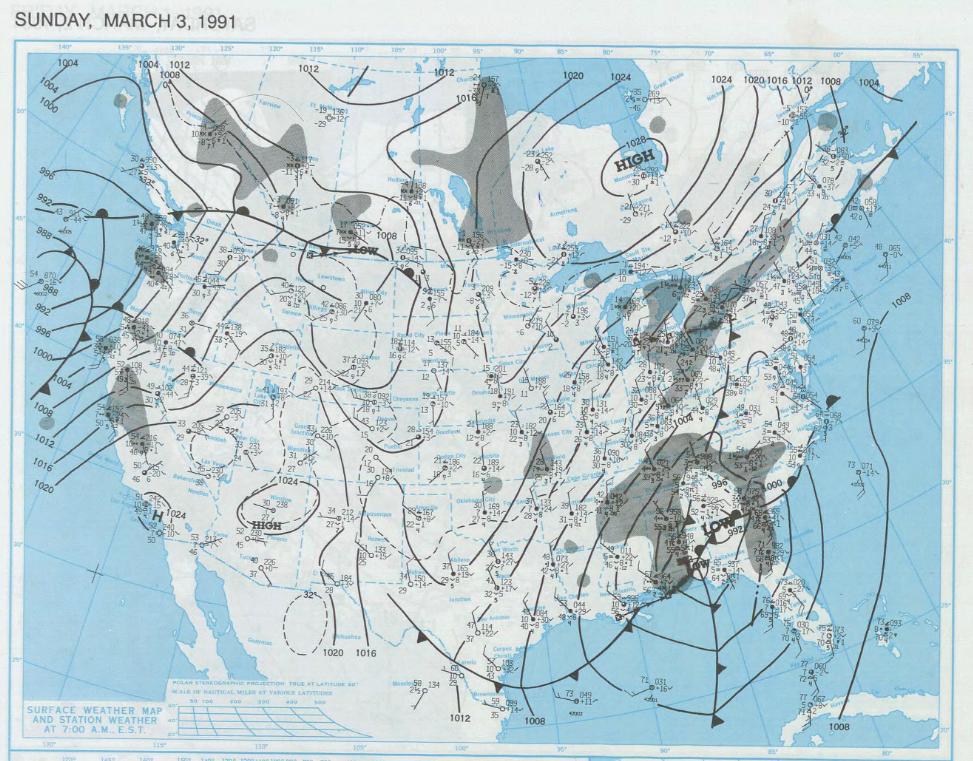
Meteorologist Kevin Williams in explaining what happened said: โ€œthe ice storm commenced on March 3, 1991. It resulted from low-pressure tracking from the south into central and eastern New York. This allowed warm air from the Gulf states to flow into the upper levels of the atmosphere over Rochester, while northeast winds at the surface drew subfreezing air into the area from Ontario. Snowflakes which fell from the cold clouds above melted into raindrops upon reaching the warmer layer above the surface, only to freeze upon reaching the ground, where temperatures were below 32 degrees.โ€

Weather Daily Charts from the National Weather Service

Sunday, March 3, 1991, Weather Map as of 7 am
Monday, March 4, 1991 weather map as of 7 am

Greece along with the rest of Monroe County was in the โ€œsweet spot.โ€ Again, quoting Kevin Williams: the storm โ€œproduced a 50-mile-wide band of freezing rain aligned along the Genesee River Valley. While Syracuse to the east experienced rain, Buffalo to the west had mainly sleet and snow. But Rochester endured 17 hours of continuous freezing rain resulting in an ice accretion of more than one inch.โ€

It started at about 10:30 pm on Sunday, March 3, and by the early morning hours of March 4, people were awoken by what sounded like rifle shots. It was tree limbs cracking and falling to the ground. Electrical wires and telephone lines came down with the trees. Paul Holahan, Greece’s Commissioner of Public Works at the time, was alerted to the problem at 2 am and by 4 am knew it was a major event. He called John Yagielski, the school superintendent to let him know that the schools needed to be closed. They would be closed for a week.

If you like to see the Unedited version of Paul Pakusch’s 10-minute video that was posted in 2010. It Starts at Paul’s, home and yard, then his drive to work, later in the day, and the next two days around his neighborhood. Florida Ave, Dewey Ave, Seneca Parkway, Lake Ave, East Ave, Tiernan Street, River Heights, Perinton Street, California Drive, Haviland Park. Paul Pakusch worked for WHEC Channel 10 at the time during the 1991 Ice Storm.

Also if you like you can check out the March 11, 1991, NewsTeam 10 special from the Ice Storm the folks that run Rochester TV Archives on YouTube have archived that broadcast and you can check it out here.

Aerial view of police headquarters on Island Cottage Road, 1983 from the Office of the Town Historian

Crews were especially needed to clear the main streets and others were needed to pump water when, because of the lack of power, the sewage pump stations failed; the police headquarters was flooded nearly every dayโ€ for a week with raw sewage. The police station itself was also without electricity and was working through an emergency generator. Fire crews didnโ€™t bother going home, but worked around the clock.

Storm Shelter Locations

Hundreds of thousands of homes and businesses were without power, some for as long as two weeks. Sometimes one side of the street had power and the other did not; neighbors shared generators and long extension cords snaked over lawns and driveways. Two days after the storm the temperature plummeted; shelters were set up at Hoover Drive Junior School and the Greece Assembly of God Church. In North Greece, Irene DeMay opened the doors to Hotel DeMay as a shelter as well. You can learn more about the Hotel DeMay in Snapshot 25.

Customers Without Power – WHEC’s Ice Storm Coverage March 1991 you can watch the WHEC NEWS TEAM 10 coverage of the Ice Storm on YouTube on the Rochester TV Archive channel https://youtu.be/T8ebkxRG3Fc
Aerial view of Hoover Drive Junior High, the 1940s, from the Office of the Town Historian
Greece Assembly of God
Ice storm damage, 1991, photo by Bill Sauers

Trash didnโ€™t get picked up and mail wasnโ€™t delivered for two days.

More than three thousand trees in the town of Greece were damaged. DPW crews were busy into June clearing away brush and tree debris and hauling it to the Flynn Road transfer center; 400,000 cubic yards of it or enough wood to build 7,000 homes.

Still from Paul Pakusch 39 minute video from the 1991 Ice Storm
Ice storm, 1991, from the Office of the Town Historian

In the aftermath of the Ice Storm of ’91, the town, already operating on an austerity budget and waiting for FEMA money, had to borrow money to meet expenses by the end of the year; RG&E started a rigorous tree-trimming protocol, and residents were left with indelible memories of terrible destruction as well as breathing-taking beauty and stories to tell for generations to come about cold nights, helpful neighbors, and surviving the โ€œStorm of the Century.โ€


“April is the cruelest month,”

โ€” The Waste Land by T. S. Elliot, Poet

The poet T. S. Elliot said that โ€œApril is the cruelest month,โ€ but weatherwise for Greece, itโ€™s the month of March. Out of the top ten worst snowstorms in Rochesterโ€™s history, four were in March. The 1984 Leap Day storm lasted more than five days, bringing more than 30 inches. There were two blizzards at the beginning of March 1999, dropping 42 inches of snow. We got off relatively lightly during the โ€œStorm of the Centuryโ€ on March 12, 1993, with 23 inches of snow, thunder, and lightning.

Snowiest and Least Snowest Marches from 1896 to 2021 using data from Weather.gov and NOAA

Wind Storm of 2017

On March 3, 2017, we had winds gusting to 60 miles an hour, bringing down trees and power lines. But that was just an appetizer for what Mother Nature had in store for us less than a week later. Blame it on the sun. It was a gorgeous day on March 8, 2017. Now the forecast did call for high winds. But most people thought it would be a repeat of the 3rd. However, all that sunshine destabilized the atmosphere; the sun heated the air and as the warm air rose it created a vacuum and air rushed in to fill the vacuum, that is wind.

Formation of wind as a result of localized temperature differences. http://www.physicalgeography.net/fundamentals/7n.html
Blue dots are Wind Speed, Greece Triangles is the Wind Gust, Gray is the Peak Wind

Winds gusted to 40, 50, and 60 mph much of the day, broke 70 mph around 1 p.m., and then hit an astonishing 81 mph at 1:35 p.m. Trees came crashing down onto streets and on top of homes and on Long Pond Road utility poles fall in a row like a set of dominoes. 40,000 homes and businesses lost power in Monroe County, a large portion of them in Greece.

Repair work was delayed as the high winds persisted into the next day, making it too dangerous for crews. Utility workers from all over came to assist RG & E. Local hotels were full of residents so a crew from Canada was billeted at the Greece Community Center. Some homes were without power for two weeks.

Repairs on Long Pond were delayed due to the lack of enough utility poles to replace all the broken ones. Weโ€™ve had more wind and ice storms since these two big ones, which is why whenever ice or wind is in the forecast, we hope it wonโ€™t be as bad as the Ice Storm of 1991, or the Wind Storm of 2017.

Thanks for joining us today. Join us again next week as we pay tribute to the soldiers of World War I.

mail

Bicentennial Snapshot # 33: Extreme Weather Part 1

Today we will be talking about some historic weather events.

1816 and the effects of Mount Tambora eruption in Greece New York

In 1815, the largest eruption of a volcano in recorded history occurred; Mount Tambora, in Indonesia erupted spewing so much ash into the atmosphere that global temperatures dropped dramatically in the summer of 1816 causing unusual cold and food shortages. 1816 became known as the year without a summer or โ€œeighteen hundred and froze to death.โ€

Painting of Mount Tambora erupting
Mount Tambora can be seen via space using satellite imagery, by NASA

The volcanic dust carried around the globe on the jet stream covered the earth like a great cosmic umbrella, dimming the Sunโ€™s effectiveness during the whole cold year. The eastern United States, Europe, and China were hugely affected. It caused widespread crop failures, famine, and 90,000 deaths, many from starvation.

The 1815-1816 winter in the northeastern United States was milder and dryer than usual. However, just when it should have been getting warmer, at the beginning of spring, the weather turned colder and frosts were widespread. Farmers held off planting through April and May. By the first week of June, milder weather had returned and farmers rushed to get their crops sown. On June 6th a storm brought freezing temperatures and snow. Crops planted only a week earlier were lost to frost. Throughout the summer the temperatures swung back and forth; no sooner had farmers planted a crop than a frost would wipe out most of the plantings.

Illustration from Pioneer History of the Holland Purchase of Western New York by Orasmus Turner 1849
Dead corn photo by G. Houston from Wikimedia Commons

Cold weather and frost returned again in July. With temperatures in the 40s during the day, people began to worry about famine. On August 6th, another round of winter weather arrived. What vegetation had survived the previous episodes were now destroyed. Once again, another warm period followed but it was too little, too late. A killing frost came in late September, two weeks earlier than usual. Then the winter started again. Many families left New England and migrated west, including to the Genesee Valley.

Our area was still pretty much a wilderness in 1816 and accounts of that summerโ€™s impact are sketchy. MacIntosh in his history of Monroe County says that โ€œthe cold season produced a partial famine.โ€ Wheat couldnโ€™t be cut until September and the corn crop was a failure. Henry Oโ€™Reilly in his Sketches said about wheat: โ€œThe “cold summer” of 1816 was not injurious to our crop.โ€

First Settlement in Rochester 1812, engraving by Alexander Anderson, 1838
Sunset at Braddock Bay Marina by Douglas Worboys

Q: What was our mitigating factor?

Q: What was our mitigating factor?

A: Lake Ontario of course. Then as now, the Lake impacts our weather.

The modifying effects of the lake on temperatures were particularly conducive to fruit farming and Greece had numerous orchards where farmers grew apples, peaches, and cherries.

Orchard on Payne Farm, Elmgrove Road, 1910, from the Office of the Town Historian
Ice covering the Great Lakes on March 4, 2014 (second highest coverage since record-keeping began in 1970) from NASA

Lake Ontario is the smallest of the Great Lakes in surface area, but the second deepest and so is the least likely of the five to freeze over completely. The Canadian Ice Service (CIS) has been keeping statistics since the 1970s and has calculated the likelihood of the lakes freezing to the point where 90 percent of their surface is covered in ice. Lake Erie is the most likely to freeze with a chance of 69%; Huron comes next at a 22-per-cent probability, followed by Superior at 17 percent and Michigan at 11 percent. Astoundingly, the CIS estimates that Lake Ontario has a mere 1% chance of having 90% ice coverage.

The Great Lakes as seen from space by NASA, April 2000

1934 Cold Snap Hits the Orchards Businesses

Headline from Hilton Record, February 15, 1934

This brings us to the winter of 1934. Temperatures in February of that year were icy. On February 9 the thermometer dipped to minus 22 or lower; the high temp that day was minus 3. That is still the official record low for the Rochester area.

They did not keep records of ice coverage back then, but anecdotal evidence from both sides of the lake, says that Lake Ontario froze over completely that month.

Blue is the Highs in 1934 the Green Line is the Lows

Called the Big Freeze by local farmers, it destroyed most of the fruit trees. Apple trees split in half. Never again would there be so many orchards in the town of Greece.

1934, of course, was the height of the Great Depression. Men on work relief earned 25 cents an hour chopping the dead fruit trees into firewood. They also got to keep some of the wood for themselves.

Damaged fruit trees in Greece, 1934, from GHS
Firewood cut from former orchards, 1934, from GHS
Lake Ontario after March 13-14, 1993 snowstorm

Surprisingly the winter of 1933-34 was not particularly snowy. We have certainly had some memorable snowstorms in this town by the lake. This photo was taken after the March 13-14,1993 blizzard which dumped more than 24 inches of snow on Greece. It was part of the larger so-called โ€œStorm of the Centuryโ€ which pummeled states all along the east coast from the Carolinas to New England with not only huge amounts of snow but hurricane-force winds. Letโ€™s take a closer look at the Blizzard of โ€™66, which occurred in the days before modern snow removal equipment such as snowblowers.

Blizzard of 1966

The green line is the Snowfall in inches. The blue line is the Precip that is not Snow

The Blizzard of 1966 was a historic storm for Greece and all of western New York. Nearly 27 inches of snow fell on the last two days of January.

This was on top of about 18 inches of snow from the week before.

Dewey Stone area Blizzard of โ€™66, 1966, photo by Bill Sauers
Snow on the roof meets snow on the ground, Blizzard of โ€™66, 1966, photo by Bill Sauers
โ€œSnowhereโ€ to go! Blizzard of โ€™66, 1966, photo by Bill Sauers
“Snowhere” = Snow and nowhere put together as a pun meaning with the amount of snow non of the Town’s citizens could get anywhere in the town due to the amount of snow that was dropped on the city.

Winds whipped wickedly making for poor traveling conditions. Not only the schools but businesses and government offices were shut down for a week.

Town officials set up and operated storm headquarters at the Greece Memorial Hall at 2595 Ridge Rd. W. Ham Radio operators, Amateur Radio Emergency Service (ARES), Civil Defense Radio operators, as well as town officials, which included Supervisor George Badgerow, Milton Carter the Chief of Police, Civil Defense Administrator Walter Whelehan, as well as a representative from each of the four fire companies in the town.

Fun Fact the Monroe County 9-1-1 center did not begin operating until February of 1986 and Greece did not hook up to the system till years later, and on a side note in snapshot 37 the Holiday Inn Fire could have been prevented with an automated system that dialed 9-1-1 and sent the alert to first responders that topic is for another day, now back to the Blizzard of 1666.

Without the invention of Morse Code and Ham Radio, there would have been more widespread communication problems to get information in and out of the town of Greece to other parts of the region. For those that are interested in learning about what it takes to earn a ham radio license and become a member of your local ARES group check out the ARRL.org and ARRL.org/public-service, also check out the local club in Rochester, The Rochester Hams https://rochesterham.org/

Greece Town Hall on Ridge Road, 1998, from the Office of the Town Historian
Civil Defense Seal
Current Logo Of ARES
Cars buried in snow, Blizzard of โ€™66, 1966, photo by Bill Sauers

The Greater Greece Post reported that โ€œSnowmobiles were stationed at the Town Hall and Highway Department Garage to transport physicians on emergency calls. Two ambulances also were stationed at the Town Hall. A supply of milk and bread was kept available for delivery.โ€ Some milk trucks and bakeries started selling their products to customers right from their delivery vans stopped at partially cleared street corners.

Toboggans were kept in readiness so that sick or injured persons could be removed over the deep snow. Standby snow-clearing crews were stationed near all firehouses to accompany fire trucks answering alarms.

Snow clogged parking lot at Nick and Erwin Dry Cleaners, Blizzard of โ€™66, 1966, photo by Bill Sauers
Dewey Avenue near Barnard Fire Station, Blizzard of โ€™66, 1966, photo by Bill Sauers

โ€œThree drug stores were alerted so that medicine could be obtained and taken where needed. Fifty prescriptions for insulin alone were delivered by town personnel and volunteers.โ€

Some residents used an alternative mode of transportation.

Horses on Dewey Avenue, Blizzard of โ€™66, 1966, photo by Bill Sauers
This Cat is sick of the snow and wants to get farther than the edge of the driveway
Photo by Bill Sauers
This Cat is sick of the snow and wants to get farther than the edge of the driveway
Photo by Bill Sauers
Mountains of snow, Blizzard of โ€™66, 1966, photo by Bill Sauers
This person does not realize he is walking on top of a car
Photo by Bill Sauers

Fun Fact: The plow that is sitting in front of the DPW is from the Truck that plowed Long Pond Road during the blizzard of ’66.

On its 40th anniversary, local meteorologist Scott Hesko still ranked the Blizzard of โ€˜66 in the top three worst storms of all time.

Thank you for joining us today. Next week we turn our attention to ice and wind events. Especially the 1991 Ice Storm and the Wind Storm of 2017.

mail

Bicentennial Snapshot # 32 – Ghost Legends Of Greece NY

Today we will share some ghost stories that have been passed down over the years.

man in black crew neck t shirt holding jack o lantern
Photo by Yaroslav Shuraev on Pexels.com

Halloween is fast approaching and itโ€™s the time of year traditionally set aside for tales of ghosts and haunted houses and other unaccountable phenomena. We donโ€™t have to go far from home to find any number of stories about spirits from the world beyond. Today weโ€™ll share with you a few of the stories that have been handed down over the years and even some hauntings of more recent vintage.

Our Mother of Sorrows Church has been designated by local ghost hunter and the author of Haunted Rochester, Mason Winfield, as the areaโ€™s โ€œmost significantโ€ haunt. Mason Winfield’s Haunted Rochester is available on amazon.com or where ever books are sold

Haunted Rochester A Supernatural History of the Lower Genesee by Mason Winfield
Our Mother of Sorrows Church photo Bill Sauers

Greece Legends: Enchanting Tales of Indains, a Pirate, a Peddler, Men, Women, Childern, Great Balls of Fire, The Death of the Light, Leperchauns and Ghost … these folk stories relate to the bodies of water along the lakeshore, and some come from Paddy Hill, evidencing the Irish Settlers’ love for bewitching tales. It has been said that exorcism was needed for a house on Island Cottage Road. Believe it or not here are the tales as they have been told.

Eight Miles Along the Shore, Chapter 16 Believe It or Not – Greece Legends Page 106

Four Handpicked Ghost stories from the Town of Greece

The Tale of Footsteps over Head

Told by a Custodian that worked at Mother of Sorrows

Interior of 1870 church from dorchurches.com
Our Mother of Sorrows Cemetery from Bill Sauers

One tale concerns the church custodian. Every night at 11:00 he took care of the furnace fire so that the church would be warm in the morning. One night as he was going about his chores in the church basement, he heard footsteps overhead, as if someone was walking up the aisle to the altar. He thought it was probably the priest and dismissed it from his mind. But the same thing happened again night after night and the custodian could think of no reason why the priest should be in the sanctuary every night. Finally, it got to be too much for the poor man to endure. He had to find out if it were indeed the priest walking above his head every night.

But he didnโ€™t want to go upstairs to the church alone, so instead, he hurried down the path past the cemetery to the rectory. There he found the priest sitting in his study; he said that he had been there all evening reading. Now this custodian was not a superstitious man. He did not believe in ghosts and gave no credence to the stories he had been hearing about strange happenings around the church and cemetery. He was certain there must be some logical explanation for the footsteps in the church. Nevertheless, from that night on, the custodian fixed the fires at ten oโ€™clock and he was never again bothered by the footsteps of the invisible walker.

The Phantom Man

Walter Whelehan

from Eight Miles Along the Shore book

The Whelehan family seemed to be particularly receptive to psychic phenomena; Walter Whelehan often told stories of phantoms they encountered. Their home was on Latta Road next door to Mother of Sorrows Church and his bedroom overlook the cemetery. He told of a phantom man who visited the Whelehan family on several occasions. He would stand at the corner of their driveway. One night Walter came home to find his parents in his darkened bedroom peering out the window.

As Walter approached the window, his mother asked him if he had seen anything unusual as he came in the drive. โ€œNo, I didnโ€™tโ€ Walter said as he knelt beside his father. When he looked out the window, he saw a man standing at the corner of the driveway where he had just turned in. The man wore a long, loose-fitting, dark-colored coat and a hat pulled down to shield his face. The three of them watched for a while, and then he just โ€œdriftedโ€ away in the direction of the graveyard. This occurred again and again, until one night Walter could no longer stand it. He was determined to find out what would happen if he approached the figure. His parents begged him to leave it alone, saying that it might โ€œdraw him away.โ€ Their pleading fell on deaf ears, however. Armed with a gun, young Walter started out. He said to his parents, โ€œI promise not to leave the yard and if I do, call Chief Carter from across the street because I will be going against my will.โ€ Cautiously, he walked down the driveway, never taking his eyes off the figure. At first, he could see the man quite plainly, but as he got about halfway to the road, the figure just โ€œdriftedโ€ away as it had before. They never saw the phantom man again.

Walter Whelehan home courtesy of Alan Mueller
Black and White of Patty Hill Cemetary with a glow on the Tombstones by Douglas Worboys
Phantom Man

Youโ€™ll find more of Walter Whelehanโ€™s ghost stories and others in chapter 16 named “Believe Or Not – Greece Legends of Yore” in Eight Miles Along the Shore available in the museum gift shop.

The Ghost of the Charlotte Genesee Lighthouse

Many people believe that the ghost of the Charlotte Lighthouse is Cuyler Cook. Although he was no longer the assistant keeper at the time of the accident that took his life, nevertheless he died while serving the light. By this time the light had been moved to the end of the Charlotte pier. During a terrible storm on the night of August 18, 1853, the current assistant light keeper and Cookโ€™s cousin, Sam Phillips, was unable to reach the light alone. Cuyler Cook took it upon himself to row Phillips out to the light and hold the boat while the light was lit; sadly, while Phillips was attending to the pier light, Cook’s boat capsized in the rough waters, drowning him. Believers in the Charlotte Genesee lighthouse ghostโ€”blamed for disembodied noises, footsteps, and sundry other mysterious happeningsโ€”attribute the disturbances to Cook.

Rocks of the Koda-Vista neighborhood

Koda Vista
Koda Vista
Front Page of The Greece Post from December 6, 1973, on nyshistoricnewspapers.org

But Who-done-It? Shower Ends, Phone’s Quiet…

On December 9, 1979, the Democrat & Chronicle ran an odd six-year-old story that first appeared in The Greece post. volume 7 – No. 29, December 06, 1973. On the front page of The Greece Post for December 6, 1973, the Headline reads “But Who-done-It? Shower Ends, Phone’s Quiet”. FYI there is a conflict of address between the two articles written by the two papers The Greece Post puts the address on Carmas Drive off of Weiland Road between Long Pond and Latona Road, and the Democrat and Chronicle story put the address on Corona Road in the Koda-Vista Neighborhood. The Greece Post reported the incident in question occurred at the home of Mr. and Mrs. Frank Marrella. But there is more to the story. There will be a link to the Greece Post from December 6, 1973, for you to read and piece your own ideas of what could have happened in those four days. Can read the article in its entirety below at NY State Historic Newspapers website.

https://nyshistoricnewspapers.org/lccn/sn88074413/1973-12-06/ed-1/seq-1/

For several nights starting on Thanksgiving night in November 1973 and lasting for four days, a home in the Koda-Vista neighborhood was showered with rocks of varying sizes. None was bigger than a baseball. Of course, the authorities checked into every imaginable possibility for a logical explanation. Human vandals were the first suspected even with the slim chance that they could have remained hidden. But these rocks came from many directions. There would have had to have been secret caches of them all over the neighborhood, as well as a conspiracy of covert and well-timed hurlers. During one onslaught, the police came in full force, sealed off the tossing range, and combed it thoroughly. Not only was the search for throwers fruitless, but the assault kept up the entire time, even targeting police cars. Fortunately for all, the wonder was over in five nights.

According to the article, in the Greece Post, there were some other strange things that happened while the house was getting pelted by the rocks. Officers from the Greece Police brought four cars two offices in each of the four cars as well as two additional officers were stationed in the house with the Marrellas taking turns watching the house. Rocks kept coming even at 4 a.m. But that’s not all, the article also mentions that Marrellas’ telephone began ringing two nights before that and rang for hours at a time, with no one there when she answered. At the time she said she “wrapped it in a towel” and when she went back, the line was still open.

The telephoning bothered them for several nights and the rock pelting continued for four nights Damage included a broken window and gouged doors. Cars parked in the street were hit and so was a neighbor’s garage door.

With nerves still frayed, Mrs. Marrella said this week, “We still don’t have any idea where the rocks came from. This is a quiet Neighborhood. Everybody minds their own business. We don’t think we have any enemies. I say hello to my neighbors, and we like everybody.”

The Marrellas’ came to Greece from the city two years ago and had the house built “just the way we wanted it” They like Greece and want to stay.

roasted turkey on white ceramic plate
Photo by Karolina Grabowska on Pexels.com
Hurled Rocks
Hurled Rocks
gray rocks and mountains under the cloudy blue sky
Photo by Esequiel on Pexels.com

So, what caused this rocky rain?

Unlike typical ghostly or even UFO sightings, plenty of evidence was left behind. Where did so many flingable rocks come from? The oddest effect of this whole event was not the damage that was caused, but the damage that was not caused. Think of a random firing of stones; if you lobbed a couple hundred into an average neighborhood how many people do you think you might hit in a week? How many cars? This shower broke a few windows and gashed the sides of the house, but as far as it is known, no one was injured.

Closing Thoughts

Paranormal experts see the Greece case as a classic example of a poltergeist outbreak illustrating one of the distinguishing features of documented poltergeist outbreaksโ€”people should have been hurt, could hardly have avoided being hurtโ€”and they were not.

Thank you for joining us today. Next Two Tuesdays we will explore some extreme weather events over the years that affected the town of Greece starting with the eruption of Mount Tambora in 1815 all the way up to the Ice Storm of 1991 and then most recently the wind storm of 2017.

mail

Bicentennial Snapshot # 31 – Notable homes in Greece, NY

Today we will take a virtual tour of some of the other notable homes in Greece, New York.

Larkin-Beattie-Howe House – 595 Long Pond Rd

This beautiful vernacular 19th-century farmhouse is home to the Greece Historical Society. Many of us have moved from one home to another, but this is a house that has moved twice. Circa 1924, when it was located at the southwest corner of Latta and Long Pond Roads, the Beatties didnโ€™t like the noise from the neighboring tavern. So, they transferred the house onto oak timbers and rolled it back from the road to a new foundation. The house is significant because of its association with pioneer families in Greece, but more so for its connection to Gordon A. Howe. He lived in the house with his family from 1941 to 1965. This political legend was the supervisor of the town for 30 years before becoming the Monroe County Manager for eleven years. The Monroe County Office Building is named for him.

595 Long Pond Road Larkin-Beattie-Howe home photo by Bill Sauers

In 1966, Wegmans Food Markets purchased the property. They were going to demolish the house; however, in 1988, under the initiative of Town Supervisor Don Riley, Wegmans sold the house to the Society for $1.00 and generously funded moving it to what is now the Greece Town Campus. The cupola on the front lawn once sat atop the Ridge Road town hall. The Historical Society was founded in 1969 and when it was less than a year old, the society organized a historic house tour. There were four homes on the tour, but the beauty of a virtual tour is we can escort you to a few more homes all from the comfort of your own home.

Covert-Brodie-Pollock House, 978 North Greece Road

As stated in Snapshot 30, in October 1998, three years after being added to the National Register of Historic Places, the Covert-Brodie-Pollock House was the first designated landmark in the Town of Greece. There are three other homes that are also designated town landmarks. Also, you can check out our Landmark Page as well on the Covert-Brodie-Pollock House.

Covert-Brodie-Pollock House, 978 North Greece Road, from Bill Sauers

The Joseph Fleming House, 981 Latta Road

981 Latta Road, Joseph Fleming House from GHS

The house of Joseph Fleming, a town pioneer, is located at 981 Latta Road; it became a designated town landmark in October 2012. Fleming, who was a master stone mason before he turned to farming, built the house circa 1854. This beautiful Italianate-style home was the centerpiece of Flemingโ€™s 300-acre farm. The main block is two stories high with a hipped roofed and is flanked on both sides by a one-and-a-half-story wing. Atop the roof is a widowโ€™s walk with โ€œa fanciful balustrade and pointed finals above each corner pedestal.โ€ Did the residents climb to the roof to see Lake Ontario just 2 miles to the north? Joseph Flemingโ€™s descendants resided here until 2008.

The Rigney-Feeney House, 1885 Latta Road

The Rigney-Feenney house at 1885 Latta Road stands on the western slope of Paddy Hill and is another designated town landmark, achieving that distinction in 2000. It was the home of the pioneer Rigney Family. Built around 1850, it is โ€œa late example of the Federal style of residential architecture,โ€ characterized by the beautiful front entrance, symmetrical windows, and louvered shutters. The house was built to last and endure fierce weather with โ€œnine-inch square beams of oak set into a foundation two feet thick.โ€ Patrick Rigney was a farmer and fruit grower with 250 acres surrounding the house. His children occupied the house until the early 1940s. In the 1950s, parts of the old farm to the west and south were developed into the Picturesque Acres and North Point housing tracts and the Greece School District purchased about 35 acres of the property for Paddy Hill Elementary School. The fourth owners of the house, Mr. and Mrs. Robert Feeney undertook to restore the interior of the house to its original floor plan updating amenities for themselves and their seven children. It was Mr. Feeneyโ€™s home for more than 60 years from 1952 until he died in 2014.

web History Page Buildings1885_Latta_Road-Rigney-Feeney-House
1885 Latta Road The Rigney-Feeney House from GHS

William A. Payne House, 505 Elmgrove Road

505 Elmgrove Road William Payne House photo by Bill Sauers

The William A. Payne House became a designated town landmark in October 2012 shortly after being listed in the National Register of Historic Places in June.

The home was built circa 1905 for William A. Payne who as Monroe County Sealer of Weights and Measures impacted local and state commercial practices. He was one of the founders of the statewide association that established fair and uniform methods of weighing and measuring products benefitting both merchants and consumers. He also developed education programs for fellow sealers.

505 Elmgrove Road William Payne House from GHS
505 Elmgrove Road William Payne House photo by Bill Sauers

This house, typical of several along Elmgrove Road, has aspects of both Queen Anne and Colonial Revival architecture, a trend at the turn of the last century. Queen Anne-inspired features include the asymmetrical floor plan, the complicated roof design, fish-scale shingles, and bay windows. Colonial Revival aspects are the cornice returns at the gable ends and the square posts of the front porch. The former carriage barn is now a garage.

Colby-Shearman House, 1777 Ridge Road West to 550 Latona Road

Just like the Larkin-Beattie-Howe house this house also moved from one location to another but this one move was shorter than the Larkin-Beattie-Howe House.

Zaccheus Colby, a prominent Greece farmer, built this 10-room, pink Dutch brick, Italianate-style farmhouse in 1855. In 1872 he sold it to his brother-in-law, Abner Shearman. The Shearman family continued to reside in the house until 1970. Construction of 390 threatened the house, so Miss Suzanne Shearman spent 75,000 dollars to move the house from its original location at 1777 Ridge Road West to 550 Latona Road.

550 Latona Road, Colby-Shearman House, 2022, photo by Bill Sauers
550 Latona Road, Colby-Shearman House, 1968 from GHS

That was quite an undertaking. The house had to be cut in half, moved on a flatbed truck, and set on a new foundation. Upon Suzanneโ€™s death in 1970, the house was sold to the Bierworth family.

In 1979 the Wegman Companies, Inc. headed by Philip Wegman purchased the house for their headquarters. They realized the importance of this beautiful historic structure and have made every effort to preserve and maintain the buildingโ€™s architectural integrity.

550 Latona Road, Colby-Shearman House, 2022, photo by Bill Sauers

Yates-Thayer House Now called Holiday Fleming Point, 710 Latta Road

710 Latta Road Yates-Thayer House, 1998, photo Greece Historical Society

When the Western New York Landmark Society surveyed buildings in the town of Greece in 1994, it lamented that this home was in such derelict condition; indeed, it had been condemned by the town. When a developer planned a senior living facility on the property, he was going to demolish the barn and convert the house into apartments.

Fortunately, the Town’s Historic Preservation Commission, along with the New York State Historic Preservation Office (New York SHPO), stepped up and helped to save it. The developer of Fleming Point Senior Living Center, at the time when the building was being rehabbed the exterior of the house and the barn using recommendations from the New York SHPO (pronounced “ship-o”). 

Gina DiBella, former chairperson, and the late Gloria Latragna, a former member of the Greece Historic Preservation Commission pose in front of the Yates-Thayer House to celebrate Historic Preservation Month.
710 Latta Road Yates-Thayer House, 2006, photo Greece Historical Society

This house was built for the coal and railroad industrialist Arthur Yates circa 1902 probably as a summer home. The site is the former Patrick Fleming farm; he was the younger brother of Joseph Fleming. The property became known as Elmtree Farm. The house is โ€œan outstanding example of Neo-classical styleโ€ identified by the front faรงade dominated by a full-height portico with details such as carved wood ornamentation, both Doric and Corinthian columns and pilasters, and windows with six panes on the top and a single pane on the bottom. Although Neo-classical was a dominant style at the turn of the last century for public and institutional buildings it was not common for private residences.

A bonus is the gambrel-roofed barn with its large round-arch loft opening and twin louvered, cross-gabled cupolas.

710 Latta Road Yates-Thayer House, 2006, photo Greece Historical Society
710 Latta Road Yates-Thayer House, 2006, photo Bill Sauers

In 1914, the home was purchased by Samuel Thayer and remained in the Thayer family for 80 years. Over the years the house and barn were converted into several apartments. In 1994, it was purchased by Joseph Coco, who later sold the property to the developer of Fleming Point Apartments in the early 2000s. In 2007, the house and barn were purchased by Greece businessman David Wegman of the Wegman Group. Dave and his family rehabbed the interior into offices for their business and rented out space to other businesses.

FYI … The Thayers sold the property to Joseph Coco, who stripped the interior of all its details. (Joe Coco also purchased the Hotel DeMay and his wife Kim was one of the owners of the DeMay when it was demolished.)

FYI … The Wegman Group and WCI are NOT the same businesses. Gina DiBella believes WCI is owned by Dave’s brother Phil.

There is also a publication written by Marie Villone Poinan which is a 22-page book with illustrations and photos chronicling the history of the Yates-Thayer property.

Carpenter-Toal-Latragna-Stauffer House, 3490 Latta Road

3490 Latta Road photo by Bill Sauers

Weโ€™ve already told you about the Carpenter and Toal families that lived in this home. The house started as a simple one-and-a-half story home when it was constructed circa 1840; it was expanded into its present-day late Greek Revival style about 1860. It has a porticoed temple front. Notice the elongated facade and narrow pillars and there is some unusual carved woodwork, such as the small diamonds at the top of the Doric columns. The Landmark Society survey said that the craftsmanship was outstanding. Lou and Gloria Latragna purchased the home from the Toal family and strived for many years to maintain the building’s integrity and share its history. After their deaths, it was sold to Fieldstone Capital in August of 2015 and then Fieldstone Capital sold it to Mark Stauffer on 09/08/2020 at the cost of $115,000.

According to Monroe county, property tax records the property had two new updates done to the property one was a machine shed in 1980, and in 1990 a ramp was added to the porch for access into the first-floor area of the house.

This photo is of the homeโ€™s living room, one of the few interior shots we have, to see some other interior pictures see the Democrat and Chronicle article for some other pictures.

3490 Latta Road Living Room, date unknown, from GHS

Here is an article written by Ernst Lamothe Jr. on the Democrat and Chronicle website on April 17, 2014, called Latta Road Home hosted lots of fun you read more by clicking the link below

https://www.democratandchronicle.com/story/news/local/rocroots/2014/04/16/latta-road-home-hosted-lots-fun/7704273/

Thomas W Boyde, Jr. Designed House, 442 Edgemere Drive

Thomas W Boyde, Jr. Designed House, 442 Edgemere Drive – Photo by Bill Sauers
Thomas Boyde 1930 NY Architects Office cropped to headshot
Thomas Boyde 1930 NY Architects Office, cropped to headshot

Not all notable homes in Greece are more than a hundred years old. The Greece Historical Society is sponsoring a historic resource study of the work of Thomas W. Boyde, Jr., Rochesterโ€™s first African American architect. This mid-twentieth-century house is on Edgemere Drive. Mr. Boyde designed at least three other homes in the town. You can learn more about Thomas W. Boyde, Jr., and the research project we are sponsoring by clicking on the Boyde Project at the top of the page.

These are just a few of the beautiful, interesting, historic homes and buildings in our neighborhoods. Drive around the streets of Greece and see what you can find. Please comment on Facebook if you know of other Iconic Homes in the Town.

Thank you for joining us today; next week in our Halloween special we will tell you about some of the townโ€™s ghostly inhabitants.

mail

Bicentennial Snapshot No. 30: Cobblestone houses, Part 2

Today we continue our look at cobblestone structures in Greece.

Three Cobblestone Houses Featured are

Covert-Brodie-Pollock House, 978 North Greece Road

Covert-Brodie-Pollock House, 978 North Greece Road Photo By Bill Sauers

The Covert-Brodie-Pollok House is located on a 14.95-acre site on the east side of North Greece Road in the southwest quadrant of the town. The designation area incorporates the main house (1832), an attached garage at the rear of the house (the early 1940s), a contributing well, a non-contributing shed, and a non-contributing storage barn. A 14-acre expanse of lawn surrounds the house on the north, east, and south. The property is historically significant for its long association with the Covert and Brodie families. The Coverts were early 19th-century settlers/farmers in the North Greece area and the builders of this house. The Brodie family and its descendants, also farmers, have owned the property since 1914. The Covert-Brodie-Pollok House is architecturally significant as an outstanding example of an early-19th-century, Greek Revival cobblestone farmhouse retaining a high degree of integrity of design, materials, and craftsmanship. Cobblestone architecture is unique to the Central and Western New York areas of the country. It developed in the late 1820s when settlers who were clearing land and preparing fields for planting collected cobblestones as building materials. It is one of four existing cobblestone buildings in the town of Greece.

The Covert-Brodie-Pollock House at 978 North Greece Road is a sterling example of cobblestone architecture. It was constructed in 1832 for William H. Covert and except for the years 1840-1850 when it was owned by Amos Trowell was occupied by members of the Covert family until 1892.

Gilletteโ€™s map of Monroe County, 1858, from the Rochester Public Library Local History and Genealogy Division

The 1858 county map indicates that the home belonged to J. B. Covert, that is Joshua Covert, and

F. W. Beers, Map of Monroe County, 1872, from the Rochester Public Library Local History and Genealogy Division

The 1872 map shows William R. Covert as the owner.

The homeโ€™s ownership passed through several other owners between 1892 and 1914, including Elmer Burlington, George Harris who maintained a 125-acre stock farm surrounding it, George Emerson who lost the house betting on a horse race, and Louis Zagata.

Pencil Drawing of 958 North Greece Road from Cobblestone Architecture by Carl Schmidt, 1944
Illustration of Cobblestone pattern of 978 North Greece Road from Cobblestone Architecture by Carl Schmidt, 1944, p. 82

The cobblestones for 978 North Greece Road were meticulously chosen: only a few are round, and the majority are oblong in style ranging from 1.5 inches to 3 and 4.5 inches long. They are primarily brown, yellow, or gray with very few rose-colored stones. The builder emphasized the horizontal in the rows and the quoins which are the masonry blocks at the corner of the walls. The cobblestones cover just the faรงade of the walls which are 18 inches thick.

The front faรงade features a wide frieze band (1) with four windows with decorative iron grilles (2), cornice returns (3), windows with limestone lintels and sills (4), and a front entrance with a gable-roof porch and Doric columns (5).

Covert-Brodie-Pollock House from Office of the Town Historian
Example of a Keeping Room: interior view, first floor, west wall of kitchen showing fireplace and doorway into keeping room Naylor House, Swift & Silver Lake Roads (Middletown Township), Langhorne, Bucks County, PA, from Library of Congress

The house at one time included a living room, dining room, bedrooms, a borning room (where mothers gave birth), a kitchen, and off the kitchen a keeping room. A keeping room was usually the warmest room in the house being next to the kitchen and its heat source whether a fireplace or a stove. While the cook prepared the meal, others would sit in the keeping room, close enough to talk to the people preparing a meal, but at the same time, out of the cookโ€™s way. The Keeping room also served as a borning room where there wasnโ€™t a separate room for that purpose and was also frequently used as the last resting place for the dying. Recently, having a keeping room became a trend in new homes being built.

In 1914, Walter and Katheryn Brodowszynski (whose name is horribly misspelled on this map) purchased the property. They changed their last name to Brodie in the 1920s.

Environs of Rochester Maps by G. M. Emerson, 1931 from the Rochester Public Library Local History and Genealogy Division
Covert-Brodie-Pollock house, photo by Bill Sauers
Covert-Brodie-Pollock house from GHS

After Walterโ€™s death in 1946, Katheryn sold the house to their eldest daughter Helen (who went by the name of Kay), and her first husband, Robert Zielinski. Kay acquired sole ownership of the house in 1959.

Headline from Greece Post, November 27, 1969

Kay Brodie lived in this house all her life, and with her second husband William Pollock, was its loving caretaker. Many of the changes to the interior, including installing plumbing and mechanical upgrades and combining rooms, Kay did herself. It was always her desire to get the home listed on the National Register of Historic Places.

That dream was realized in 1995; in October 1998 it became the first in the Town of Greece to be designated a landmark. According to the Landmark Society of Western New York, โ€œThe Covert-Brodie-Pollok House is architecturally significant as an outstanding example of an early-19th-century, Greek Revival cobblestone farmhouse retaining a high degree of integrity of design, materials, and craftsmanship.โ€

Westfall-Mercier House at 4350 West Ridge Road

In contrast to the well-maintained beauty of the Covert-Brodie-Pollock home is this house located on West Ridge Road, not far from the West Greece intersection of Ridge and Manitou Roads.

Known as the Westfall-Mercier House, when it was evaluated by the Landmark Society in 1994, it was described as โ€œa lovely, charming cottage on a beautiful site.โ€ It is a fine representation of a Federal-style farmhouse and may have been constructed as early as the 1830s, but no later than 1852.

The earliest owner for whom there is the documentation for a J. Westfall; heโ€™s named on an 1852 map. From the late 1940s to approximately 2000 the owner was Raymond W. Mercier.

Westfall-Mercier House, 4350 West Ridge Road, 2007, photo by Bill Sauers
Westfall-Mercier House, 4350 West Ridge Road, 1980s, photo from the Office of the Town Historian

Margot and Ralph Gram

Headshot of Margot Gram from Hilton Record, November 11, 1943

Margot and Ralph Gram owned the house for a brief interlude, the years 1946 and 1947 approximately. She was an interesting woman. As a vaudeville performer, she toured all over Europe collecting antiques. She transitioned to being a cabaret singer before becoming the first female radio announcer in New York City. Her husband, Ralph, was the voice of the Hearst-Metrotone newsreels that once were part of every movie showing. They came to this area, taking radio jobs with WHEC. She was the first person to sing George Gershwinโ€™s Swanee; when she was working at a music store, the legendary composer came in and handed her the sheet music and asked her to sing it for him.

Ad for Margot Gramโ€™s antique business from Greece Press, July 17, 1947

That old cobblestone house was the perfect venue for setting up an antique business. Although she didnโ€™t live in Greece very long, Margot became a staple appraiser of antiques for many of the Greece churches when they hosted antique shows, including Our Mother of Sorrows, Aldersgate Methodist, and Bethany Presbyterian. This, of course, was considerably before the time of eBay.

Pen and ink drawing of toy Manchester terrier by Paul Brown, 1950

Margot also raised toy Manchester terriers.

Raymond Mercier

Mrs. Scottโ€™s English Tabby โ€œCoppa.โ€, First Prize at the Crystal Palace Show, 1886.
CATS AND THEIR FRIENDSHIPS. by W.H. LARRABEE,
The Popular science monthly
VOL. XXXVII. MAY TO OCTOBER, 1890. pg 90

Years later the last owner of the home, Raymond Mercier, operated Cat Nap on the premises, boarding up to 30 felines at a time. Mercier died in 2001.

Since then, the house has stood vacant. The 600-square-foot house sits in the middle of prime commercial property. The developer has tried his best to care for the house, but it has been subject to graffiti vandalism. He even offered it to anyone who would be willing to move it off the property, but there were no takers. So, for the time being, the fate of this little house is undecided. If you have the money and the skills to move this cobblestone house it could be yours.

Westfall-Mercier House, 4350 West Ridge Road, 2016, photo by Bill Sauers

Hartman-Foos Cobblestone House

Hartman-Foos cobblestone house photo courtesy of Bill Sauers

The cobblestone house on Mill Road was home to the Hartman and Foos families for decades. It too was built between 1830 and 1852. From at least 1852 until the early 1900s, members of the Hartman family resided here. The Foos family occupied it from at least 1930 until 2016.

But on that August 11th day of 2016 at 15:23, it would be its last day as a cobblestone house.

On August 11, 2016, this historic home caught fire. According to an account written by Gene Preston of the North Greece Fire Department,

A person wearing a hat Description automatically generated with medium confidence

โ€œFirefighters worked in 94-degree temperature August 11 to save the pre-civil war house. Said a neighbor: โ€œIn no time the road and lawns were covered with fire hoses as 7 engines, a rescue truck and an aerial ladder strategically positioned themselves on Mill Road.โ€ The fire did significant damage to the structure. Firefighters had to deal with the fire and the extreme heat and humidity of the day. I took another walk through it before we firefighters left the scene nearly three hours after we were dispatched. Hopefully it can be restored, but it has some serious issues.โ€

Eugene Preston, North Greece Fire Department

Unfortunately, it could not be saved. The Foos rebuilt a house on that spot but it was not a cobblestone house. The new structure is a wood-built house

Hartman-Foos cobblestone house photo courtesy, 2016, photo by Bill Sauers
Building StyleExt. Wall TypeHeat TypeBasementLiving Area# StoriesYear Built
RanchAlum/vinylHot airR4-Full1,252 Sqft1.02017

So, now there are only three cobblestone homes left in the Town of Greece. There are other stone-based houses and brick buildings but as for cobblestones there are 3 remaining structures left and hopefully, the lessons learned from the Hartman-Foos fire could be used to preserve the remaining three buildings.

Thank you for joining us this week. Next week we will take you on a virtual tour of some of the other notable homes in the town.

mail

Bicentennial Snapshot # 29 – Cobblestone Houses Part 1

This week and next we explore some of the cobblestones houses in the town of Greece. Did you know that when the mile-thick glaciers of the Ice Age melted and receded north thousands of years ago, they left unique marks on the terrain and interesting mountains, lakes, rivers, streams, valleys, and some rich and fertile land for growing crops, as well as boulders, cobbles, pebbles, field stones, gravel and sand deposits in different areas that make up different regions in the world? The glaciers left 5 big freshwater lakes behind, how many of the big lakes can you name?

Satellite image of Lake Ontario -November 2009 NASA Earth Observatory

We will go from the west to east starting with Lake Superior, and Lake Michigan, flowing into Lake Huron with Georgian Bay, a small lake between Huron and Eire called Lake St. Clair, then Lake Erie, at the Buffalo end of Lake Erie is the Niagara River which brings the water over the falls at Niagara Falls and in then into Lake Ontario after the water travels out to the Atlantic Ocean via the St. Lawrence River. But for this snapshot, we will be focusing on New York State. In New York State and more especially within minutes you could be at Lake Ontario from anywhere in the town or a 40-to-50-minute drive from Greece you could be in the finger lakes looking at the beauty that the glaciers left on this region. Remember when we explained in snapshot 11 The Ridge Part 1 about Lake Iroquois? Those who may not remember earth science class or other science classes and parts of some history classes when they talked about the Ice Age and how most of the region was covered in ice and glacial valley, also called glacial trough as seen in this map. Almost 13,000 years ago a large glacial lake, Lake Iroquois, as it is called by geologists, lapped the far eastern portion of what became the Niagara escarpment. When the waters of Lake Iroquois receded, it left a ridge of land 400 feet above sea level. You can see on this map, the dimensions of the prehistoric lake in relation to Lake Ontario today.

Lake Iroquois
Lake Iroquois

Notice the red line that is the Ridge Road portion from the Genesee River to Lewiston., the /// lines going from lower left to upper right that is the outline of Lake Iroquois, the cross lines ### in the pen are the ice sheet as the ice continued to recede north as the time when on from the ice age.

And in Bicentennial Snapshot # 19 – Henpeck, Hoosick, and Hojack, whatโ€™s in a name, part 2 we looked at some of the elevations in the town from its highest point to the lowest point the town and how the town has two natural ridges.

But that wasnโ€™t all; hundreds of thousands of cobblestones, fieldstones, and gravel pits were deposited in the glaciersโ€™ melting wake. Cobblestones have a round shape. Over the years water made boulders become cobbles, cobbles become pebbles, and pebbles become sand. According to the Cobblestone Museum, โ€œGeologists classify cobblestones as being 2.5 inches to 10.1 inches in size. In lay terms, cobblestone is a stone that can be held in one hand.โ€ This differentiates them from fieldstones, which were also used to construct houses.

During the Program โ€œSet In Stoneโ€: The History Of Cobblestone Masonry, on September 13, 2022, Douglas Farley mentioned that there was a least one cobblestone structure as far away as Colorado. This is mentioned at 12 minutes and 21seconds in the video. https://youtu.be/eJAgwjKHCcw?t=1286

closeup of cobblestone house photo Bill Sauers

Some of these cobblestones, fieldstones and gravel pits were found while excavating for the Erie Canal, some were found while farmers were prepping the fields to grow crops. The town has a few remaining cobblestone structures left. There are a couple of fieldstones and one other stone-style house in the town. One of the fieldstone houses in the town is on the grounds of Unity Hospital at 1563 Long Pond Road. Some of the cobblestone houses may have had the back walls built with fieldstones because beauty in the front and the so ugly back fieldstone was not seen from the front. Why wasnโ€™t brick used for these buildings? Well, one writer said โ€œIn the early days of the western New York frontier, bricks were costly to transport. To make them locally was also costly since clay had to be procured and molded, kilns had to be built, etc.โ€ The farmers and masons used the material they had readily available and that โ€œmaterial did not require painting or maintenance; and most important, was fireproof and weatherproof.โ€

1563 Long Pond Rd

School District # 9

  • School district 9 school also Greece Methodist Church mid1800s GHS
  • District School 9 Facing Southeast

One out of the 17 district schools and the 2 joint districts in the 1800s were built using cobblestone the rest of the school districts were built with wood. The cobblestone school was in school district 9 on the 1872 map of the town of Greece and it was located at 980 Long Pond Rd. In 1917 it was replaced by a two-room schoolhouse. The cobblestone school was sold for $ 5.00. Arthur Koerner and Willis construction firm were awarded the contract to build the new two-room wooden school at 1048 Long Pond Road. Also, The Greece United Methodist Church formed inside School Number 9 on July 25, 1841, when Reverend William Williams met with a group of people to start the church, and then another group meeting at the Greece Center schoolhouse at district school number 17 on Latta Road and the church grew to 21 members. The current two-room schoolhouse was later sold at a district auction in August of 1949 and was purchased by Harold Tebo. Harold then hired Arthur Koerner to draw up plans to convert the schoolhouse into a private home and one of the features of the old school hidden above the now lowered ceiling is a tin ceiling that was used to reflect the heat and keep it in the building.

First Christian Church

The First Christian Church was a church that was built out of cobblestone, and it was located at 3194 Latta Road, it was close to the Larkin-Beatie-Howe House where that house used to sit where Wegmanโ€™s now sits. The Frist Christian Church used the church until 1866, then Greece Methodist Church used it from 1867 to 1874. Then Greece United Methodist Church built a new church with brick on Maiden Lane and has been there ever since. The former church at 3194 Latta Road was torn down around the 1950s.

First Christian Church then Greece Methodist Church Latta Road GHS

Davis-Bagley-Hazen House

The first cobblestone house we will look at will be the Davis-Bagley-Hazen House at 149 North Greece Road it was built in 1845 in the Frisbee Hill area, and it was built by Edwin Davis. Lucius Bagley purchased the home from Edwin Davis in 1856 and the 100 acres surrounding the house. The house is a 3 Bedroom, 2 Bathrooms and 1 Half Bath the house has one fireplace. The property now sits on 2.61 acres out of the 100 acres that used to be farmland owned by Lucius Bagley, and the houseโ€™s living space is 3,376 square feet. It also has a cobblestone-built smokehouse in the rear of the house.

Davis-Bagley-Hazen home from Town Historian

One of Luciusโ€™ children, Henry Joel, inherited the house and farm; he lived there all his life until he died in 1942, at the age of 90. A Bagley cousin remembered that โ€œit was a standing tradition among the Bagley descendants to celebrate Christmas Day with grandfather Henry Joel at the old cobblestone farmhouse.โ€ Bagley descendants also remembered watching their โ€œgrandfather salting and preparing bacon and hams to hang in the cobblestone smokehouse that remains by the driveway today.โ€

Henry Joel Bagley
Henry Joel Bagley
149 North Greece Road smokehouse

The next longstanding owners of the house were Stanley and Mary Hazen. After purchasing the home in 1958, the Hazens made substantial upgrades and improvements to the old cobblestone farmhouse; nevertheless it โ€œretains its rural, exterior dress, yet tasteful planning has transformed the dwelling into a modern up-to-date home. There is a definite feeling of preservation from within with no sacrificing the conveniences of utility, interior decorations, and livabilityโ€ฆ.โ€ In 1989, the Finegans became owners of this historic house.

The Landmark Society considers this house โ€œarchitecturally significant,โ€ not only as โ€œan outstanding intact example of cobblestone construction in New York State,โ€ but also as a significant โ€œexample of mid-nineteenth century Greek Revival, rural domestic architecture in the Town of Greece.โ€

District School # 7

District School 7 Map
District School at 150 Frisbee Hill Road
150 Frisbee Hill Road Today

Children attending District School #7 on located at 168 Frisbee Hill would come down the hill with pails to fetch drinking water from the pump by the front porch of the Bagley house. Their teachers were often boarded there during the school season. The schoolhouse was built for $700 on a quarter-acre plot of land leased by Edward Frisbee, a North Greece pioneer, in September 1833, and stipulated that the land was to be used for school. Mrs. Cancella was a teacher at the one-room schoolhouse. Lou Frisbee was the bus driver. The school had about 15 students and went from K – 10 or 11 grade. In 1899 the original schoolhouse on Frisbee Hill just past North Greece was torn down. District 7 lost its old school by Court rule. Florence Haskins at 150 Frisbee Hill Rd. sued Myron B. Kelly, serving as a trustee of the school district for possession of the schoolhouse and the quarter-acre of land her great-grandfather had turned over for school purposes. Dorothy Frisbee used to serve soup, sandwiches, and cookies to the kids if they didn’t bring any lunch says Ruth a former student. The most difficult time was in the winter on the bus because she said the winters were tough and it was difficult for the bus to get through the snow. The roads weren’t plowed like today and the drifts were quite high. She didn’t remember how they heated the school, but she said it got quite cold inside on occasions in the winter.

Next week

Next Tuesday will look at a few other cobblestone houses but for one it was not able to be saved and that is a tale for next week. Bicentennial Snapshot # 30 – Cobblestone Houses Part 2

For More on Cobblestones buildings from this Snapshot

The Cobblestone Church at the Cobblestone Museum in Albion, NY

Some of the information for this week and next weekโ€™s snapshot comes to us from the Douglas Farley and the Cobblestone Museum in Albion, New York you can check out their museum at https:/www.cobblestonemuseum.org/ as well as the program he did at our Tuesday program called โ€œSet In Stoneโ€: The History Of Cobblestone Masonry

mail

Bicentennial Snapshot # 28 โ€“ Jerome Combs, The Cobblestone Baseball Catcher

Jerome Combs from RGE news September 1938

This week we introduce you to Jerome Combs, the cobblestone baseball player. Did you know that some baseball players would use cobblestones as baseballs?

Well, one player could catch cobblestones and played for the North Parma baseball team and practiced catching them, which people said could not be done.

This snapshot is dedicated to the late Tom Sawnor (1961-2021). We appreciated Tom’s contributions to the Greece Historical Society and Museum. We will miss him and may his love for sports live on.

Jerome A. Combs was born on September 12, 1861, to Lewis Combs and Sarah Anne Combs. His parents moved from the town of Middlesex, in Middlesex County, New Jersey, to North Greece, in Monroe County, New York around 1840 to 1850 based on census data dated 1855 for Lewis A. Combs. The birth of Lewis Combsโ€™s first son born in 1855 in North Greece, coincided with Doctor Abdiel Bliss Carpenter living in the area as well. Dr. Carpenter may have been the doctor who helped Sarah Anne Combs deliver both Jerome A. Combs in 1861 and his brother Lewis A. Combs in 1855, or more likely it was his son, Dr. Abdiel Milton Carpenter.

Map of North Greece 1872
Jerome A Combs property in 1902 North Greece

Lewis Combs owned two businesses and had a reasonable sized farm as well. The first one was the Blacksmith and Carriage shop where the North Greece Fire Department started in 1922 at the northeast corner of Latta and North Greece Road. The second business was a butter churn factory. He had a truck farm as well. His sons Lewis and Jerome helped worked the farm when they came of age. Both Combs boys went to School Number 6 on College Ave. Combsโ€™s Truck Farm would take fruits and vegetables to local wholesalers or the Rochester Public Market in the city. They would load the truck or horse and wagon and be on the way by 4 am to the public market and would spend a good portion of the day selling what products they had from the wagon or truck depending on the day of the week. Some of the Combsโ€™s fruits and vegetables may have been sold to H.C. Phelps General Store, Waggโ€™s General store on Lake Ave, or Andersonโ€™s General store at Ridge and Greece Center Road (otherwise known as Long Pond Road). Also, the Larkin Hotel may have bought produce from the Combs to serve at meals for patrons at the hotel.

1954 Town Seal on the Town Flag
N Greece Fire House 1926
Directory of the Clio Lodge, 1927, from hipstamp.com

Jerome Combs was the town assessor for twelve years, and he was a volunteer with North Greece Fire Department for twenty years. Jerome Combs was one of the founding members of the North Greece Fire Department. He was a member of Clio Masonic Lodge in the village of Hilton once called North Parma.

North Parma Baseball Team, Jerome Combs is seated in on the left in the first row,  from RGE News September 1938
North Parma Baseball Team, Jerome Combs is seated on the left in the first row, from RGE News September 1938

But in the late 1880s and the early 1890s, Jerome Combs was the star catcher for North Parmaโ€™s semi-professional baseball team. In the team picture attached to the left here, Jerome Combs is seated in on the left in the first row. He propelled them through long winning streaks. But what was more interesting and made him legendary in the semi-pro leagues was his unique abilityโ€ฆ What might that be? Was it his hitting stances? Was it his ability to communicate his signals to the pitcher?

cobblestone baseball
cobblestone used as a baseball
1887 Baseball Card from "The Baseball Glove Comes to Baseball, 1875," www.eyewitnesstohistory.com
1887 Baseball Card from “The Baseball Glove Comes to Baseball, 1875,” www.eyewitnesstohistory.com

It was none of those. It was his ability to catch barehanded. Jerome would catch either baseballs or cobblestones (that were used as baseballs when no baseballs were available to use) with his bare hands. Seen here is an 1891 catcherโ€™s mitt vs. a modern catcherโ€™s mitt; look at how different they are in terms of how the glove sits on the hand and how the ball rests in the pocket of a modern baseball glove.

E. H. Decker's GATGHERS GLOVE
E. H. Decker’s Catcher’s GLOVE
Wilson A2000 2021 1790SS 34″ Catcher’s Mitt

If you want to learn more about the evaluation of catcher equipment can be found on the Society for American Baseball Research (SABR) website. https://sabr.org/journal/article/the-evolution-of-catchers-equipment/

Jerome would catch baseballs thrown as far as 150 feet and as close as 3 feet, but for the pitching distance, it was 50 feet. One of Jeromeโ€™s quotes from the days he played baseball was

โ€œI guess, I was the only man who had the reputation of being willing to catch any pitcher at fifty feet using cobblestones for baseballs. Folks who didn’t know me used to bet it couldn’t be done.”

Old Time Baseball played  on the grounds of the Town Hall 5-14-16
Old Time Baseball played put on by the Rochester Baseball Historial Society on the grounds of the Town Hall 5-14-2016 – https://rochesterbaseballhistory.org/

One day he was summoned from the fields where he was working to catch for John Smith, a pitcher with a Rochester team, one of those who said it could not be done. They started throwing at 150 feet. Then, it gradually shortened the distance to fifty feet. Combs, described as a gentle giant of a man, came through with flying colors as he always did.

Did his hands suffer any damage?

They did not. He explained his technique: โ€œI learned to absorb the shock of the stones and the baseballs at fifty feet by pulling back my hands with the catch at fifty feet. Then I kept them in shape by soaking them in hot water after each game.โ€

And on the day, he died his obituary headline read โ€œFormer โ€˜Barehandโ€™ Catcher, Jerome A Combs, taken by deathโ€ on August 30, 1940.

If you want to learn about some of our local hometown athletes that have gone on to the pro level or just had some records set at local high schools besides Jerome A Combs, then get yourself a copy of our publication written by Marie Villone Poinan the late Tom Sawnor.

Hometown Sports Heroes of Greece NY
mail

Bicentennial Snapshot # 27: โ€œThe Cooperโ€ Tom Toal

This week in our bicentennial snapshot for September 20th, 2022 we explore Thomas F Toal a cooperage owner, a barber, and a worker from Kodak who grew up on the Parma Greece border.

Topics Covered in this snapshot

Thomas F Toal Bio

Thomas F. Toal was born on August 26, 1866, and grew up in Parma, Monroe County, New York. He was a cooper before going to work at George Eastmanโ€™s Kodak where he worked for 12 years and then retired back to the North Greece/Parma area to be back in the country. He died in 1948 and was laid to rest in Our Mother of Sorrows Cemetery at the corner of Latta Road and Mount Read Blvd.

Carrie L. Frisbee

Carrie L. Frisbee was born in 1864 in North Greece, Monroe County, New York she is a niece of Edward Frisbee the owner of the land that was leased to District School # 7 on the family land, the school was located on the north side of Frisbee Road, and east of North Greece Road. (Attach a Map of the location here). Carrie L. (Frisbee) Toal died on 1 January 1957 and she was laid to rest next to her husband Thomas F. Toal in Our Mother of Sorrows Cemetery at the corner of Latta Road and Mount Read Blvd.

Left Carrie L. Frisbee | Right Thomas F Toal
This is a map of District 7 from the 1872 Map of Greece, New York you can see all the land that is owned by the Frisbee family

What is a Cooperage? What is it nowadays?

According to Wikipedia: A cooper is a person trained to make wooden casks, barrels, vats, buckets, tubs, troughs, and other similar containers from timber staves that were usually heated or steamed to make them pliable. Journeymen coopers also traditionally made wooden implements, such as rakes and wooden-bladed shovels. In addition to wood, other materials, such as iron, were used in the manufacturing process. The profession is the origin of the surname Cooper.  A Cooperage was responsible for making the barrels that were used to store foods, wines, whiskeys, and other drinks or other items that needed to be preserved compared to canning or vacuum sealing or bottling of fruits, vegetables, and drinks in glass jars.  A cooperage would make different size barrels depending on what was going in the barrel. Some of these barrels had gunpowder in the barrel, or maybe pickles, flour, crackers, dried beans, wheat, apples, corn, carrots, or other fruits and vegetables. Some were just used to hold umbrellas, tools, and other items to keep them organized.

Some of the barrels that Tom Toal made ended up in New York City to a buyer who either was for a big farm or a business in New York City that shipped products over to Europe and other places that wanted fresh goods from America in the late 19th century to the early 20th century.  Depending on what the barrel was going to be used for the cooper would choose the right type of wood the most common wood was oak it depends on where in the world it was made. Modern wooden barrels for wine-making are made of French common oak (Quercus robur), white oak (Quercus petraea), American white oak (Quercus alba), and more exotic Mizunara Oak. All typically have standard sizes. Recently Oregon Oak (Quercus Garryana) has been used. The links next to each type of oak will take you to the Wikipedia page on each of the different oaks.

Cooper Tools

Here is a picture of the tools that a Cooperage would use to make the barrels.

cooper's tools from Pinterest
cooper’s tools from Pinterest

Below is a picture of the different size barrels that a cooperage would make the smallest for dry goods would be a Rundlet which was 1/14 tun, the next size up would be a Barrel at 1/8 tun, and the next size up after a barrel is a Tierce at 1/6 tun, the next size after a Tierce is a Hogshead at 1/4 tun, followed by a Puncheon, Tertian at 1/3 tun, then a Pipe, Butt at 1/2 tun, finally the biggest barrel would be a Tun. But for liquids, there would be a gallon-size barrel that held one gallon of liquid.

Types of barrels revolutionarywarjournal.com

Below are two charts from Wikipedia that explains the English Wine and Brews barrel storage and amounts:

Wine Cask Chart

gallonrundletbarreltiercehogsheadpuncheon, tertianpipe, butttun
1tun
12pipes, butts
11 1/23puncheon, tertian
11 1/324hogshead
11 1/2236tierce
11 1/222 2/348barrel
11 3/42 1/33 1/24 2/3714rundlet
11831 1/2426384126252gallons (wine)
3.78564.14119.24158.99238.48317.97476.96953.92litres
11526 1/43552 1/270105210gallons (imperial)
4.54668.19119.3159.1238.7318.2477.3954.7litres
English wine cask units

Brewery casks

English brewery cask units[4]
gallon firkin kilderkin barrel hogshead   Year designated
        1 hogsheads  
1 1+1โ„2 barrels
1 2 3 kilderkins
1 2 4 6 firkins
1 8 16 32 48 ale gallons (1454)
= 4.621 L = 36.97 L = 73.94 L = 147.9 L = 221.8 L
1 9 18 36 54 beer gallons
= 4.621 L = 41.59 L = 83.18 L = 166.4 L = 249.5 L
1 8+1โ„2 17 34 51 ale gallons 1688
= 4.621 L = 39.28 L = 78.56 L = 157.1 L = 235.7 L
1 9 18 36 54 ale gallons 1803
= 4.621 L = 41.59 L = 83.18 L = 166.4 L = 249.5 L
1 9 18 36 54 Imperial gallons 1824
= 4.546 L = 40.91 L = 81.83 L = 163.7 L = 245.5 L

H. C. Phelps Connection with Tom Toal

When Tom Toal was 21 years old, he went to work for H. C. Phelps making barrels; some were used in H.C. Phelpsโ€™s General store or sold from Phelpsโ€™s Store. This is where Tom learned the trade of making barrels to be used for different types of goods. Within a few years of working for H. C. Phelps, Tom started his own cooper business making barrels and selling them. While Tom ran his own cooperage he had customers from local farms, general stores, breweries, wineries, and other businesses that needed barrels to store items in. In 1972 Frank Toal was interviewed and explained his dadโ€™s cooperage and shared some of the stories with us, below are a few quotes from Frank Toal.

Phelps general store Latta and North Greece Roads sketch William Aeberli 1970 GHS

” … my Dad began making barrels in early, August. He bought his staves in the rough and once a year an agent from New York City came up to take the order for staves, ‘hoops and headings.โ€

โ€œThey were shipped out to North Greece in box cars on the old Hojack Line. Weโ€™d go down to the station with racks up on the hay wagons and load the supplies.โ€

“Dad’s business was spread clear down to the lake and over to the Parma town line.  He even had a warehouse down at Braddock Bayโ€ฆIn those days the whole section was apple orchards and Dad would ride his bicycle all around the countryside and take orders from the farmers or collect his moneyโ€”he never learned to drive a car!โ€

The most interesting thing that Frank said during the interview was that his dad never learned to drive a car.

Larkin Hotel William Aeberli Greece Post 1971 October 14
Larkin Hotel William Aeberli, Greece Post 1971 October 14

Tom Toal and His other Trade

One of Tomโ€™s other trades was being a barber; Tom was one of those men who believed in hard work and hardly allowed himself to have an idle moment, so he took up being the village barber. He worked two nights a week in a second-floor room at the Larkin Hotel charging the proverbial two bits (25 cents) for a shave and a haircut.

Tomโ€™s Connection with Doctor Abdiel Bliss Carpenter

After 18 years as a cooper, Tom bought the old Conway land and became a farmer. His farm was next door to Dr. Abdiel Bliss Carpenter. Years before, when he was a lad in his teens, he would do odd jobs for the old doctor.  The Doctorโ€™s beautiful house and estate made a lasting impression on Toal. But you wonโ€™t believe this but after twelve years of city living, he decided to move back to the country but not to any house but the estate of Doctor Abdiel Bliss Carpenter and lived there the rest of his life.

Carpenter House sketch by Wm. Aeberli Greece Post 1972 February 17
mail

Bicentennial Snapshot # 26 – Doctor Abdiel Bliss Carpenter

Dr. Abdiel Bliss Carpenter from W.H. McIntosh, History of Monroe County, New York, 1877

Abdiel Bliss Carpenter was born in Seneca, Ontario County, New York, on May 11, 1809. He was the son of Daniel and Lydia Smith Carpenter. He attended one of the small one or two-room schoolhouses in the town of Seneca in Ontario county, then went on to attend Geneva Academy which now is the home of Hobart and William Smith Colleges in Geneva, New York. At the age of 17, Abdiel Bliss Carpenter was certified to teach in Benton, Yates County which is 15 minutes to the south and west of Hobart and William Smith Colleges by taking Pre Emption Road south. But Abdiel was more interested in becoming a doctor and practicing medicine; he wanted to care for people instead of teaching people. So, he began an apprenticeship with Doctor Anthony Gage in Ontario County before moving to North Greece. In 1827 he moved to North Greece / Jenkin’s Corners and continued his training with Doctor M.B. Gage who lived in North Greece.

In 1830 at the age of 21, Abdiel Carpenter married Jane Louesa Rowleyof North Greece. They settled down in a small house behind the brick church on the northwest corner of Latta and North Greece Road.

Jane Louesa Rowley grew up on the southwest side of North Greece Road not far from Jenkinsโ€™ Corners. Her familyโ€™s farm is now home to North Greece Fire Station and its North Greece Road entrance. The Rowley homestead was located directly across from the entrance to College Ave. This photo of the Rowley homestead was in a photo album recently donated to the Greece Historical Society and which we were thrilled to receive.

As you can see on this 1858 map of North Greece there are two Rowley properties one is the S.S. Rowley the other one is the H. Rowley property. The Rowley homestead in the picture to the right is that of H. Rowley.

The Rowley homestead in North Greece, from GHS
North Greece map 1858
Fairfield Medical College, Fairfield, NY
Fairfield Medical College, Herkimer, NY
Abdiel Bliss Carpenter Degree to be a Doctor

It was common practice at that time for someone who wanted to be a doctor to attend medical school after acquiring some medical training. The year after his marriage, the twenty-two-year-old Abdiel Carpenter went to the Fairfield Medical School in Herkimer, New York. Fairfield Medical College closed in 1840, due to competition from other medical colleges opening in New York and surrounding states. This is when many of the other colleges and universities like Syracuse University and the University of Rochester were founded.

He attended Fairfield Medical College college 10 years before the school closed for good. He graduated and earned his degree to practice Physic and Surgery on January 3, 1830.

Abdiel Bliss Carpenter returned to North Greece upon receiving his degree to practice Physic and Surgery and purchased Dr. M.B. Gage’s practice and started practicing in North Greece. His career as a doctor spanned 34 years. During that time, he would keep a record of all the children he assisted into this world just like Doctor Samuel Beach Bradley did in Hoosick.

Doctor M.B. Gage was a Commissioner of Common Schools from 1827-1831.

Carpenter ledger from Edward G. Miner Library
sketch of Abdiel Bliss Carpenter Greece Post 1972
double-breasted Prince Albert frock coat

Frank Milton Carpenter son of Abdiel Milton Carpenter, described his grandfather Doctor Abdiel Bliss Carpenter as “a serious practitioner, a self-made man of no-nonsense personality.” Frank remembered that his grandfather always wore a Prince Albert Coat and top hat.

What is a Prince Albert Coat?

A Prince Albert coat: “a double-breasted frock coat usually with a flat velvet collar, becoming in vogue after a visit to the U.S. by Prince Albert in 1876.” The Prince Albert coat is a variant of a Frock Coat.

What is a Frock Coat?

According to Wikipedia, A frock coat is a formal men’s coat characterized by a knee-length skirt cut all around the base just above the knee, popular during the Victorian and Edwardian periods (the 1830sโ€“1910s). It is a fitted, long-sleeved coat with a center vent at the back and some features unusual in a post-Victorian dress. These include the reverse collar and lapels, where the outer edge of the lapel is often cut from a separate piece of cloth from the main body, and also a high degree of waist suppression around the waistcoat, where the coat’s diameter around the waist is less than round the chest. This is achieved by a high horizontal waist seam with side bodies, which are extra panels of fabric above the waist used to pull in the naturally cylindrical drape. As was usual with all coats in the 19th century, shoulder padding was rare or minimal. Learn more on Wikipedia.

Doctor Abdiel Bliss Carpenter served two one-year terms as town supervisor once in 1843, and then again in 1848.

Grave marker of Jane Louisa Rowley Carpenter in Falls Cemetery from Find-a-grave
The grave marker of Jane Louisa Rowley Carpenter in Falls Cemetery from Find-a-grave

Abdiel Bliss Carpenter and his first wife Jane Louesa Rowley Carpenter had seven children together but she passed away in 1859. Abdiel remarried Caroline Elizabeth Carpenter and had three more children.

These are 4 of the 9 children

Two of the seven children born to Abdiel Bliss Carpenter and Jane Louesa Rowley

  • Abdiel Milton Carpenter
  • Frank Irving Carpenter

These are two of the three children that Abdiel had with Caroline Elizabeth Carpenter

  • Charles A. Carpenter
  • Helen E. Carpenter
Etching of Dr. Abdiel Bliss Carpenter, his wife Caroline, and their home on Latta Road from W.H. McIntosh, History of Monroe County, New York, 1877

Doctor Abdiel Bliss Carpenter owned land on both sides of Latta at 3490 and 3491 Latta Road. As you can see in this 1887 map below, it now shows the land is owned by Doctor A.B. Carpenter and his son Doctor A.M. Carpenter who lived right across the street from each other. Their office was on the south side of Latta Road. Eventually, Abdiel Bliss Carpenter retired to devote his time to farming and turned his practice over to his son, Abdiel Milton Carpenter, or Dr. Mit as his patients called him.

1887 Map of North Greece

Both houses still stand today. The original house at 3490 Latta Road was built around the 1840s as a story-and-a-half rectangular edifice; the small porch on the west is most likely a remnant of a porch running across the front. The house had 15 rooms after the second floor, front addition, and pillars were added in the early 1860s.

3491 Latta Rd
3491 Latta Rd
3490 Latta Rd
3490 Latta Rd

On the north side, on land that was once owned by Lewis Combs, he cleared a hundred acres and planted wheat; the first year of farming produced such a bumper crop, Dr. Carpenter was able to pay off all his debts.

agriculture arable barley blur
Photo by Pixabay on Pexels.com
The grave of Abdiel Bliss Carpenter

Abdiel Bliss Carpenter passed away on January 9, 1896, at the age of 86, and his remains are buried in the Falls Cemetery on West Ridge Road at Latona Road on the southwest corner.

mail

Bicentennial Snapshot # 25 Hotel De May

Bicentennial Snapshot No 25 - Hotel DeMay

This week we finish looking at the hotel of many names at 3561 Latta Road. It started out as the North Greece Hotel in 1908, then went by the name Moerlbach Hotel, back to the North Greece Hotel, followed by the Domino Inn and Cosmo Inn during Prohibition, the Corner House Hotel post-Prohibition, until it finally and lastly became the Hotel De May in 1946.

How many ate at Hotel De May, for Ray’s birthday, for the restaurant anniversary, or at the end of baseball season picnic in the parking lot? Some of you may have parked here when you had to respond to North Greece Station One to put out a fire or even just operate the desk and work overnight to handle the fire calls, car crashes, brush fires, or routine fire inspections. 

Raymond Archibald De May was born on 17 March 1919, in Rochester, New York. His father, Jacob Jannis de May, was born in Holland and immigrated to the USA at age 3. Both his father and his mother, Stella Lovisa Miller, were 35 when Ray was born. They lived in Rochester’s 21st ward. Ray graduated from Rochester Institute of Technology with a degree in management and then went to work for Kodak for eight years before getting into the hotel business. He married Irene in 1941.

According to the U.S., Social Security Applications and Claims Index, 1936-2007, Irene Marie Reiser was born on 03 May 1916 in Rochester, New York to parents Frank J Reiser and Cecelia Bertzman. Her parents immigrated from Austria to the United States. Based on the United States Census, 1940, Irene Marie Reiser and Raymond Archibald De May met while working at Kodak. Irene Marie Reiser married Raymond Archibald De May in 1941.

In 1946 Ray and Irene De May purchased the hotel property and building. It took the De Mays nine months to remodel the entire property, starting with modernizing and redecorating the interior to make it livelier for patrons to enjoy live music and dancing on Fridays during the winter. The De Mays upgraded the kitchen to a 1946 state-of-the-art kitchen, completely fireproofing the kitchen separately from the rest of the hotel and dining area.

Raymond installed a new 49-foot bar, enabling more patrons to sit at the bar. He could better display the different kinds of whiskey, vodka, wine, sherry, port, brandy, rum, gin, tequila, hock, vermouth, absinthe, rye, beer, ale, champagne, cognac, and sakรฉ. These were laid out in a way that Raymond felt best encouraged customers to buy lots of drinks.

Most bars and restaurants that serve a wide assortment of alcohol-based products would have a selection of what the industry calls top-shelf items. These are your higher-end priced beverages or have better ingredients, compared to your mid-tier and low-tier drinks. They did serve some of the local brews from the Genesee Brewery and others that survived prohibition.

This rough, not-to-scale hand-drawn sketch by Bill Sauers, circa 2016, shows the layout of the first floor of the DeMay Hotel. As for a ladies’ room, it probably had none for Women before the De May’s purchased the property and upgraded the plumbing. They added a ladies’ room just at the end of the bar before heading to the Ballroom / Banquet space. The men’s room was your old school trench on the edge of one wall and ran the distance of the wall with partitions for privacy, they also had some Water Closets (aka toilets) if a gentleman needed to use one. On the door was a silhouette of what appeared to be that of Clark Gable at a publicity photoshoot at MGM in 1938.

DeMay ad Greece Press 1946 November 14
DeMay floor Plan sketch drawn by Bill Sauers, circa 2016
Ray DeMay behind the bar
Clark Gable's MGM Publicity Still 1938
Clark Gable’s MGM Publicity Still 1938
Hotel De May dance ad Greece Press 1947 January 2
DeMay Hotel Greece Press 1948 September 23
DeMay's Beer Night ad
DeMay’s Beer Night ad

Based on the text of an ad in the Greece Press on January 2, 1947, the was a men’s bar. The first line on the right is “Always a Lively crowd at DeMay’s,” in the middle of the ad, it says “Western New York’s Largest Dance Floor”, followed by “Our Cocktail Lounge and Bar” and then finally it says “Where Good Fellows Get Together.” seemly to indicate it was a Men’s only bar and cocktail lounge. The woman or spouse accompanied a gentleman to the hotel but on Fridays and Saturdays from 9 pm to 1:30 am would be served drinks in the dining area or dancing in the ballroom area.

In 1948 Raymond A De May and the Hotel were charged with being a public nuisance. Raymond De May was arrested on September 10; the warrant was for maintaining a public nuisance and creating an environment that negatively affected the neighbors that lived around the Hotel De May. He was arraigned before Justice W. Arthur Rickman. Raymond pleaded not guilty to the charges and the case was adjourned to September 13, and then adjourned a few more times until the case was settled out of court.

Here is a link to the current wording of the town of Greece, NY Nuisance Law on the Town of Greece’s ecode360

Chapter 144: Nuisances

In the following years after the charges were settled out of court Ray, Irene, and their hotel would be at the heart of the North Greece Community.

Fire at Hotel De May

DeMay Fire D&C 12-19-1953

Hotel De May was almost destroyed by a fire that started in the hotel’s coal bin, on December 18th, 1953, it took North Greece, Greece Ridge, and Barnard Fire departments to put out the blaze. There was damage to a kitchen and rooms overhead the southwest wing of the hotel. Luckily no one was injured in the fire. Even though there were 2 1950s Seagrave pumpers and a 1950s Mack Fire Truck from North Greece Fire Station. The manpower of the North Greece Fire Department was not enough to put it out. That is why Assistant Fire Chief Raymond asked the chief to call for mutual aid from Greece Ridge and Barnard to assist with the fire discovered during dinner time around 5:30 pm at the hotel. It appears that the Fireproof kitchen was not completely fireproof as Ray and Irene thought it was. The total damage and repairs cost the hotel suffered was $ 4,500. The $ 4,500 they had to rebuild the southwest wing and repair the kitchen and bring it up to the Town of Greece’s building and fire codes of 1954.

Annual Events Held by Hotel De May

These are the most common Events that the Hotel De May hosted:

In October it was the annual steak dinner to mark the hotel’s opening; the annual dinner was a six-course steak dinner that ran from 1 pm to 9 pm and cost $ 6 per person according to this ad to the right in the Greece Press printed in the September 19, 1968 paper.

Every March they would celebrate Ray’s birthday and they served corned beef and cabbage for free. The bash started at 7 pm and they had an orchestra for dancing from 9 pm to midnight. As seen in this ad in the Greece Press paper on March 13, 1969.

DeMay Hotel annual steak dinner, Greece Press 1968 September 19
Raymond A DeMay Birthday ad Greece Press 1969 March 13
Raymond A DeMay Birthday ad in Greece Press 1969 March 13

Raymond A De May’s role as a civic leader

While operating the hotel, Ray got involved in the North Greece Fire Department and served five years as an assistant fire chief. Since he owned the hotel across the street, he let the firefighters park their cars in the hotel lot and also let them park the trucks in the lot sometimes as well. Ray was a life-long member of the New York State Fire Chiefs Association.

Ray was photographed conducting a bike safety program for kids in the North Greece Area in which members of the North Greece Fire Department took part. He fastened reflectors to spurs of kids’ bicycles to help make the bikes visible to drivers at night. The attached article shows Ray installing the reflectors on David McCarroll’s bike at North Greece Fire Department Station 1. The Bike safety program also took place at 5 other points in the town besides North Greece Fire department at 3552 Latta Road; one was probably at the town hall or at Greece Ridge at the Ridge, another one was held at Barnard Fire Department, and then 3 other locations where most of the population of Greece was located during the 1950s.

Ray was also a member of the Greece Volunteer Ambulance Corps. (GVAC), which has since been disbanded in the last few years due to the four fire companies changing providers to Monroe Ambulance and the rising cost of Emergency services which the volunteer corp could not afford anymore.

50s 2 seagrave pumpers with Mack
In this picture, you see two 1950s Seagrave pumpers with Mack parked in the De May Hotel Parking Lot
Greece Volunteer Ambulance Corps Equipment, 1970s, from the Office of the Town Historian
Greece Volunteer Ambulance Corps Equipment from circa 1970s, from the Office of the Town Historian

Raymond’s Connection to Baseball and Softball

DeMay Hotel North Greece softball league 1970 July 9
DeMay Picnic G Press 9-2-1971

Each year Raymond would sponsor a very competitive men’s softball and baseball teams, as well as a junior league for boys aged 7-12 that lived in the North Greece area. At the end of the season, the De Mays would host an annual picnic for the members of the junior softball league and the little league baseball players. They also let the North Greece Playground youngsters join in as well as their parents and friends. The De Mays wound up serving 500 plus people each year with free hot dogs (more than likely the hot dogs were Zweigles brand hot dogs) and soft drinks could have been either Coke or Pepsi or a local soft drink vendor.

Hotel DeMay Softball Shirt

Raymond’s Battle With Pneumonia

In 1974 at the age of 55, Raymond passed away at Rochester General Hospital fighting a battle with pneumonia. According to his obituary in the Democrat and Chronicle, he was survived by his wife, Irene, and Raymond’s last living brother Robert J. de May (1922โ€“1984), and his wife Ruth Marie Stillman (1918โ€“2020).

Raymond A De May Obit DandC

Irene De May Takes over Operations

In the neighborhood around Hotel De May, Irene was known as Mother De May, that because she would take in boarders who had nowhere else to go, those who worked as migrant workers at the nearby farms, and in 1991 she opened the hotel for those who needed a place to stay warm while they did not have electricity, heating oil, wood or other heating sources to keep warm during the 1991 Ice Storm. More on the 1991 Ice Storm to come later in a future snapshot on Extreme Weather that affected the Town of Greece.

Irene De May kept the tavern and Hotel running until her death in 2000.

Irene De May, 1977, courtesy of Gina DiBella
Irene DeMay, 1977, courtesy of Gina DiBella

The Fall of Hotel De MAY

Hotel DeMay Latta Rd 2007 with sign
Come What DeMay tee shirt
Come What DeMay The tee shirt

The hotel sat empty for many years; those who cherished this historic building hoped it would be restored to a functional community asset. However, developers were more interested in tearing it down and replacing it with a (Crosby’s) gas station and convenience store.

Gina DiBella led a grassroots movement to convince the town to preserve it and make it into a functional hotel, restaurant, and party house again or take on another form of business even if it was not used as a restaurant, hotel, or party house. The group had a slogan printed on shirts that read “Come What DeMAY this Hotel Stays!”

But the grassroots movement could not sway the town board and supervisor that the De May Hotel could return to life and in Early 2017 the Town approved the demolition in favor of a Crosby’s Gas station with a Dunkin’ Donuts attached. The demolition of Hotel DeMay occurred on November 17, 2017. Still, to date, nothing has been built on the site. As of this post, the current value has dropped from nearly $ 250,000 to $ 50,000. Below is the current information on the lot according to Monroe County Records for the parcel; the last table is from propertyshark.com which says it was sold to another property broker or developer, but no records are available to verify this information only the property details, lot size, and current tax and land value have been verified using the Monroe County Tax assessment page.

At Least one part of the Hotel DeMay lives on it is the 49-foot bar that Raymond DeMay installed at the hotel, which survived demolition, and has a new home at the My Apartment bar on West Outer Drive off of Mount Read Blvd. Other โ€œpartsโ€ of the Hotel DeMay also live on at The Stutson House. Several hotel room doors were used to make the bar at that location. You can still see the room numbers on the bar panels (doors).

The Landmark Society of Western New York named the Hotel DeMay to itโ€™s Five to Revive list in October of 2017 here is what they wrote:

โ€œThe Five to Revive is a list that calls attention to five properties in Western New York that are in need of investment. They are considered significant historic aspects of our shared built environment whose redevelopment can become catalytic projects for the neighborhoods and communities that surround them.โ€

โ€œThe irreplaceable historic resources listed in Five to Revive become priority projects for Landmark Society staff and programs. The Landmark Society works collaboratively with owners, municipal officials, and developers to facilitate investment and foster rehabilitation so that these structures can again play an active role in their communities. Five to Revive selection criteria include: architectural/design integrity, historical significance, degree of endangerment, potential catalytic impact, and likelihood that inclusion on list will help facilitate a positive outcome.โ€

Unfortunately, we never had a chance to work with The Landmark Society, owners, municipal officials, or developers and The DeMay became the first and (to-date) only building named to the Five to Revive to be demolished.

Demolition of Hotel DeMay 11-17-17
DeMay Bar
DeMay Bar

Property Details

Property Address:3561 Latta Rd, Rochester, NY 14612
County:Monroe
Parcel ID:44.40-1-1
School district: 264001 – Hilton

Lot Size and Property Type

Acreage:0.75
Frontage:274
Depth:119
Property Class: Vacant Land Located in Commercial Areas (330)

Current Tax and Land Value

Tax year:2022
Property tax:$ 1,973
Land value:$50,000
Market value:$50,000

Reported Last Sale of Lot

Sale date:8/9/2019
Sale price:$595,000
This is not referenced from Monroe County records this record is from propertyshark.com
mail

Our Annual Pasta Dinner

The Annual Greece Historical Society and Museum Pasta Dinner Fundraiser Sunday, September 18th, 2022 from 5:00 pm – 7:00 pm at Barnard Restaurant & Party House (Barnard Exempts) 360 Maiden Lanes.

Barnard Exempts

Dine-in or Take-Out

Food Catered by
Forest Hill Catering
cooked pasta with sliced tomatoes and green leafy
Photo by Angele J on Pexels.com

Please help us with this major fundraiser by ordering your tickets now and your tickets will be waiting for you at the dinner. Tickets may also be purchased at our museum during normal open hours or call 225-7221. Although walk-ins are welcome, we appreciate pre-orders, as we need to guarantee a minimum number to reserve the facility. For those that are dining in, there will be a cash drink and dessert bar. There will be a silent auction featuring a range of items from local businesses who are willing to help the Greece Historical Society and Museum continue their mission of discovering, researching, and preserving the history of the Town of Greece and share that history with its residents and the local community through public programs, publications, museum exhibits in digital or physical form, and accessibility to its archives and artifacts. We will be running a 50/50 raffle as well during the event. Here is a picture from our 2018 Event at the Barnard Exempts.

From our Pasta Dinner October, 2018

Every ticket ordered before September 10 will be eligible for a drawing to win a historic Greece, N.Y. 36โ€ x 48โ€ coverlet or a copy of the Pioneer Families of Greece book.

https://greecehistoricalsociety.org/museum-shop/coverlet/
https://greecehistoricalsociety.org/museum-shop/pioneer-families-of-the-town-of-greece-volume-1/

If you Like to Order tickets to the event are $ 12.00 for adults and $ 6.00 for children 5-12.

To pre-order your tickets via mail, the fillable pdf file is below that you can fill out and either email or print out and mail back to the museum.

Mail the form to:
GREECE HISTORICAL SOCIETY

PO BOX 16249

GREECE, NY 14616

Email the Museum:

greecehistoricalsociety@yahoo.com and in the Subject line please put 2022 Pasta Dinner Ticket order this way we can tell the email is for the Pasta Dinner

mail